.svg)












.png)
.png)



























.png)


.jpg)


.svg)
-cropped%20(1).svg)
.svg)
Interview with Brandon Amalani of Blushield USA on Mindhacker's Radio
Article by
Brandon Amalani
February 14, 2020


.webp)

Interview with Brandon Amalani of Blushield USA on Mindhacker's Radio with Dr. Jay Wiles
Jay: Hey, welcome to Mindhacker's Radio with Dr. Jay Wiles, a podcast for increasing mental well being, enhancing cognitive performance, improving physical health outcomes, and living life with meaning and purpose. Glad to have you here for the ride. To avoid any confusion, please know that none of the discussion heard on this podcast is intended to diagnose and treat any physical or mental illness. That's what your personal doctors are for. Now that we have that out of the way, sit back, relax, and enjoy the show.
What is up, everybody? We're back! It's been a little bit of time, which is crazy. I think it's been about a month. Took some time off for the holidays, so happy new year. We are back with a new episode, and I've got a fun one for you today. If you're new to this podcast, my name is Dr. Jay Wiles, I'm a clinical health psychologist, and I just really have a passion for helping others improve their psychological, emotional, cognitive and physical well-being. This is Mindhacker's Radio, my way to scratch my own itch on all the areas that I'm quite interested in.
Today is one that I've been interested in for a while. This subject matter is one that is kind of a hot topic in the biohacking industry, so kind of the field I'm in. It's talked about quite frequently, but I think that there's some kind of misconceptions, some general lack of knowledge and understanding because it seems like a field that's so foreign to us. We're going to dive into it deeply, so strap in, everyone, because this one's going to be quite different and quite exciting.
Again, I get a lot of questions about EMF, and mitigating the negative effects of EMF. I also get a lot of questions about our turn towards 5G telecommunications and what health impacts this may have. So I wanted to do an episode on EMF, and more specifically, EMF mitigation through some unconventional means. Even though, when we talk about the field of EMF, it's almost always unconventional, so after doing some of my own personal research and hearing some of the top biohackers like Ben Greenfield and others discuss the concept of scalar technology for EMF mitigation, my interest was truly piqued.
So I will admit, at first, I was a little skeptical and thought that this idea was a little too woo-woo, but after further exploration and testing myself, I find myself certainly less skeptical and more optimistic about this technology. All of this may sound a little cryptic, so let's just bust right into some content.
I will say, regardless of the outcome of today, my challenge to you is to keep an open mind about what you're about to hear. My guest today is Mr. Brandon Amalani. He has been involved in the wellness industry for 20 years, with a focus on Traditional Chinese Medicine and herbalism. He is the founder and owner of Shen Blossom, and an awesome company called Blushield Global USA. Brandon is dedicated to helping people elevate their conscious awareness and health, utilizing time-honored and modern methods and tools.
So Brandon, buddy, welcome to the show, man!
Brandon: Hey, thanks Jay for having me. I'm happy to be here.
Jay: Absolutely. So as you heard in my eloquent, or maybe not so eloquent introduction of my discussion of EMF, this is kind of your area, man, which is typically an unconventional area. I haven't met many people who were like children and said, you know what, when I grow up I want to be an EMF specialist, and specialize in scalar technology. So what in the world was it that got you into this? How did you become interested in health and wellness, and then in EMF mitigation?
Brandon: Well, I certainly didn't expect it myself, honestly. I actually went to college for audio engineering and human physiology as a minor. Basically I thought I was going to be a musician, growing up. So it was kind of odd to get pulled in this direction, and it really started with my journey with health. I didn't necessarily have anything particularly wrong, I wasn't trying to heal myself from anything, but I just found myself fascinated with health and consciousness, in particular. Like how what you put in your body affects how you think, act and feel.
Early on, I would say about 17 or 18 years old, I got exposed to some of the earlier radionics type devices, and some of these energy medicine devices. I thought, "Wow! This kind of seems like the future." When I started working in these circles, and we started doing treatments on people, or experiments, I should say. I just noticed that they would get better for a period of time, but then they would have the same patterns and same conditions coming back, and it was cyclical.
I made a dietary connection, and to make a really long story short, I got pulled down the path of herbalism, which led me into Traditional Chinese Medicine as a viewpoint or a window to look through and see how the mind, body and spirit interconnect. I think it's just a really holistic, good perspective of how we can view humans, and how we interact with nature, and also how these imbalances and patterns come up and come to be.
So I started with energy medicine, and got into natural exercise, herbalism, meditation, qigong, Chinese medicine, and then I'm kind of circling back around because for years I've been looking for ways to protect my two young daughters and my family and myself from the long-term dangers of EMF pollution. I really couldn't find anything that I was satisfied with, technically or from a somatic, being able to feel any changes or differences in myself, until really recently. So that's the evolution of how I got into EMF in general, it was through natural health and wellness, because it's a piece of the pie that a lot of people don't think about that affects our health and physiology on a day-to-day basis.
Jay: Thanks for sharing that. I think you're totally right. We tend to have all these conventional ideas of what makes up health, but then we either discredit or don't even view, maybe we're ignorant sometimes, to other things that we hear about maybe in the not-so-mainstream avenues, and we just go ahead and discredit it. Whether it be because we don't see any randomized controlled trials that demonstrate effectiveness, or maybe it just sounds too woo-woo for us, and then we just push it aside.
I appreciate you coming on here so that we can unpack this to make it a little less woo-woo, because admittedly, as I said in my introduction, this was something even for me as a biohacker, when I started looking at EMF mitigation and especially scalar technology for it, where I was kind of like, "Eh, I don't know about this. I feel like you're kind of pulling my leg here.."
Then when I started seeing a little bit more on your website about utilizing different types of animal studies and human urine analysis, it piqued my interest. Now the scientist in me is saying maybe this is not so woo-woo, let me try it out for myself, let me check this out on the research aspects, and we'll see if there's something more there. So that's really cool.
I'm just curious, when you were running those experiments, when you got into this, what kind of technology or devices were you using at that time?
Brandon: We were using old Rife machines with frequency generators that use an ionized plasma gas to transmit the short band radio wave signal. That short band radio wave signal was the carrier signal that carried the frequency information into and through the human body. Your body will typically sympathetically resonate with the strongest signal in the environment, so in those days when we thought that isolated frequencies were a good idea, you would say, okay, I have a counter frequency for something like lyme, or a cancer cell or something like that, and what you would do is create a resonant frequency that would actually devitalize that particular cell or organism in the body, and it will allow your immune system to get on top of getting rid of it, or attacking it, or whatever it needs to do.
Because really, there's no way around your immune system. Your immune system is the only thing that can do anything for you. So we were using energy tools like that, like biophoton analyzers, different things to pick up energetic signatures from the biofield of a human or animal, or whatever we were working on. We were able to map it out. It wasn't really as sophisticated back then as some of the biofeedback systems are today, but we were using a variety of different energy tools. Back then, various scalar-esque, zero point energy type devices, Tachyon, things of that nature.
Jay: Interesting. I'll be super interested to talk more about that as we progress along here, but one of the things I wanted to do so we don't get too caught up in the weeds, my guess is that many of my listeners are going to already know or have a semi-understanding of what EMF is, let's go ahead and describe, if you don't mind, Brandon, what EMF is. Let's just describe that, and then why is there any reason for us to be concerned or even be talking about this thing that is EMF, in regards to our health?
Brandon: What it is, is fairly simple. EMF, or electromagnetic fields or electromagnetic frequencies, are simply an energy that's usually wirelessly transmitted through the use of radio waves, different spectrums of energy on the electromagnetic spectrum. These are radiated from not only the electricity running through your walls, but Wifi routers, computers, mobile phones, even microwaves, something some people still cook their food with contains microwave radiation. Some of the more dangerous forms of EMF, one of the most pernicious and egregious types of energy that are in the environment currently are the cell phone towers and the microwave radiation acting as a carrier signal to basically make it so you can make a cell phone call.
Jay: Yes, thanks for going over that. Just to recap, these are radiofrequencies, these are magnetic fields, electric fields and dirty electricity. I would also recommend if you want a basic primer, a very down to earth, easy to understand book, one of my favorite ones is by a guy named Nicolas Pineault, which is The Non-Tinfoil Guide To EMFs. So if you really just want a very basic understanding, I'll link to this in my show notes. All my show notes can be found over at DrJayWiles.com/EMF. I like this book as an easy primer on all things EMF and EMF mitigation. So awesome, Brandon.
One of the things that I always get questions about, is we hear information from all these telecommunications companies on how there's no reason to be afraid of any type of cellular signals that are coming through into our households, into our cell phones. In the news, we hear these things like, "Yeah, maybe we shouldn't put the cell phone up close to our head, but in general, it's really not that big of a deal."
Is that something you agree with, or would you disagree with that inherently?
Brandon: It's certainly a big deal. We're essentially, on the physical level, electromagnetic water machines. We're very influenced by electrical signals in the environment, and our mitochondria, which is bacterial in nature, has evolved to sense changes in electrical currents, in magnetism, in light, in temperature, and that's how our cells and body and DNA, essentially at the core level is regulated. So there's numerous things to be concerned about when it comes to EMF. Not trying to come from a fear-mongering perspective, but it's fairly basic physiology.
Some of the most well-known and documented studies in the journals relate to the calcium channels, and relate to how we have this flood of excess calcium in the voltage-gated calcium channels. So there's that component, which relates to anxiety and depression. If a child is using a phone, they have a much thinner skull and insulation, or protection from these frequencies, or this energy. A two-minute call can alter a child's brain function for an entire hour. It causes leakage in the blood-brain barrier, it damages and breaks living DNA, so when you talk about micronucleosis, or these cell fragments that break off DNA that don't actually die, but they start to reform, yet they have mutations, you're going to see quite a bit more cancer unfolding over the years.
What's unfortunate in a lot of respects, is everybody's on a different level of the bell curve as far as how they perceive this energy and how it affects them. Some people have a really strong constitution and genetic predisposition, where they can handle a lot of stress, physically, mentally and emotionally. There's other people that don't fare so well, and almost have an allergic reaction to these repetitive frequencies of non-native radiation. The list is sky-high as far as the ramifications, but it's not always instant. People can't always feel it right away, but 5, 6, 7 years down the road, you've had that Bluetooth earbud in your ear, and then all of the sudden the heating of the tissue in that localized area starts growing in a way it shouldn't, and you start making connections.
Jay: Absolutely, and I think that is a huge distinction for us to make. A lot of people, unless you're just extremely electro-sensitive, a lot of people if they put a Bluetooth device in their ear, they're wearing their Apple AirPods in their ears, initially they may not experience anything, but the problem is we don't have really good research to show what are the long-term effects from these devices that we're using, that are "safe". We actually do have some studies to demonstrate that these aren't as safe as we may believe they are. I think the unfortunate thing that's going to end up happening is that as time goes by, we're going to get more and more data coming in demonstrating how deleterious these effects of EMF truly are for us. Then, at that moment, that's when we'll start making change, or we may not even make change. We may attribute it to something else. Maybe it wasn't the EMFs, maybe it was something else within the technology that was doing it, or maybe it wasn't the technology in and of itself. We just kind of push it aside.
That's the scary aspect of technology, and the power that these companies hold, because they have the ability to manipulate data. We've seen it happen in the past. One of the websites that I really love is EMF-Portal.org. You will see tons and tons of studies that are up-to-date (I think they update it daily) on the negative effects of non-native EMF on the body.
We'll jump in more to the biological effects in just a second, but one thing I want to make a distinction about is the difference between non-native EMF, and native EMF. I don't want people to go around thinking that all EMFs are bad, because that is untrue. So would you mind giving an explanation of non-native EMF vs. native EMF?
Brandon: Sure. Non-native EMF is created artificially through modern technology. It differs in a lot of ways from the magnetic fields and electromagnetic energy in nature. So everything that you see in nature: the light spectrum, birds, insects, animals, ocean waves; everything correlates with a specific frequency set, and it has a certain cadence and a rhythm to it, which is always changing. That's really important to note, that a lot of these frequencies we're exposed to with Wifi, they're repetitive signals and/or chaotic.
So fundamentally, if we break it down to yin and yang theory, there's chaotic energy, or randomization, and then there's coherence, or symbiosis, in nature. A lot of these frequencies that are man-made are chaotic. For example, if you look at an information carrier wave, which is the signal transmitted to carry your cell phone message across timespace; that vibrates around 800-2200 megahertz. So that, in and of itself, doesn't necessarily affect the body in a negative way, at least that's been debated. But what is disruptive to the cellular biology and the cellular communication is that information carrier wave has piggybacked signals on it, which is your information that you're putting on that. That is chaotic to the cells, and the body tries to fight it, like it would a virus. It mounts an immune response and tries to attack it.
Energies in nature, certainly there's types of radiation that are not good, I mean we're flying through photon belts all the time as we travel through the galaxies. Our planet is never in the same point in timespace, and your body is never the same, ever. That's why you can write your signature two thousand times, and try to get one of them to match up under a microscope. You're literally a different person every second, every moment. But these frequencies don't change, they don't move and they don't pulsate or oscillate in the same way that frequencies do in nature.
I know that gets a little bit technical, but essentially, these repetitive frequencies, our body and cells haven't evolved with. So our body tries to mount an immune response to them, versus if you go into nature and you're having this variety of frequencies, it's kind of the difference between a super-nutrient or a multivitamin or something of that nature; your body requires all these different nutrients. You wouldn't just eat magnesium and vitamin C and expect to be healthy. But what's happening on the electromagnetic level from all these frequencies from non-native EMF, is that we're getting stimulated with the same thing over and over, which eventually causes damage, and mounts an immune response where the body tries to protect itself from that repetitive barrage on the cell level.
Jay: Excellent. So it kind of shares the analogy of exercise, or any kind of hormetic stressor that would be good for us -- and I won't even say non-native EMF would be good for us -- but the idea is that acute stressors don't necessarily have as much of a negative effect on us as these chronic long-term stressors do. So from an evolutionary or ancestral perspective, we didn't have all these non-native EMFs like we do nowadays in our modern American, or I would say international lifestyles, too, but especially in these developed countries like America. This constant barrage of this non-native EMF, which is very different than what our biology is used to. We wouldn't exercise for hours on end, because we know that acute stressor would turn into something chronic, which would then have a deleterious or negative effect on our mind and our body, but the problem is now we are being constantly berated by this stressor that is unbeknownst to many people.
They don't know that they're actually being exposed to a stressor that is inherently speaking to their biology... I mean, am I hearing you correctly on that one?
Brandon: Absolutely. I mean, you wouldn't work out 16 hours a day, every single day, with no off days, or rest or recovery. It's exactly the same thing. You get hit with these frequencies and your body has no time to adapt and recover. This is where it gets really cool: back in the late '90s, this team that I've been working with recently, what they found out was that there's no real good or bad frequencies, which is really interesting because everybody in the EMF community tends to think, oh, Schumann resonance and these extra low frequencies are really good, because you find them in nature, and then megahertz, gigahertz frequencies, like what we see in telecommunications, those are bad because that's what's harming people. That's only partially true.
What's interesting is that you can have a frequency in the ultra-low frequency range that's not moving in a natural way -- so if you have a Schumann generator, or a magnetic pulsar that's just going, 7.83 hz, 7.83 hz, all the time, the body starts to get annoyed by that and starts to eventually mount an immune response. Even though it's within this "healthy range", what they found was that you can actually have frequencies that are in the gigahertz range that stimulate the immune system, and are beneficial, but only if they're spontaneous and last for less than 15 seconds. So the randomization, the variety, is a very big deal in nature, and it's a very big deal to our bodies as far as how this technology is working.
What's really interesting is a lot of the technologies that we've developed can actually be piggybacked on the carrier signals from your Wifi. So you can have a Wifi router that has coherent energy to it, and it will actually have a positive effect on the body. Still the same microwave frequency carrier signal, but we tend to work with scalar just because it's a lot cleaner, and for a lot of different reasons as far as its superiority as a carrier signal. But you're absolutely right, it's a stressor, and stress can be good, but this is not a stress you want on a chronic level.
Jay: Right, and it's super interesting, I guess I didn't realize that about the strengths, or the high-oscillating hertz, actually isn't as impactful as potential duration to different types of oscillations. That's actually super interesting to me, because I think I was probably one of the individuals who just thought, oh, well the higher the frequency, the worse it's going to be for your biology. What you're saying is that isn't necessarily true.
Brandon: Well, to a point. So we have this vast electromagnetic spectrum. You go high enough frequency and you're talking about ionizing radiation. It's relative, but not as much as you might think. It's really all about how a signal is transmitted, coded, and how it moves, essentially.
Jay: There was a study that I read, and I want to say that the study was done maybe in the early 2000's. I think they were inducing a signal, maybe it wasn't considered super high, maybe 1.8 gigahertz or something like that, and just repeated, pulsing exposure to that -- I want to say it was in mice. Repeated exposure to that 1.8 gigahertz signal actually induced single and double-bond strand breaks in DNA, which is incredibly scary.
So I would just encourage people to do your research. Get out there, go onto the EMF Portal, check out all these research studies. I will say, too, if you don't have a background in science or in electrical engineering, some of them may be difficult to get through, but see if you can find someone who has reviewed some of these articles and has broken them down into better, more easily understandable English for you... or whatever language. Just because it can be a little bit confusing, but there's a lot of data out there demonstrating that there are a lot of potential negative effects of EMF.
This brings me to the next point of conversation, what are these actual physiological effects? We talked a little bit about DNA damage, and the other thing that I really wanted to hone in on, because this is a buzzword for many of the health and wellness industry, and a buzzword for those in biohacking, is mitochondrial or cellular damage. I know you talked a little bit about mitochondrial damage from EMF, but maybe we could just explain what you mean and what that actually looks like.
Brandon: Absolutely. To backtrack just slightly before I get into that, there is a lot of research in a big way being done. One of the articles that I published on my website was the 30 million dollar National Toxicology Program study. The FDA just straight up funded this. Well, they didn't fund it, we the people did, obviously. We paid 30 million dollars in taxes. So what ended up happening, and this was on mice, they had a multi-million dollar facility to basically isolate, because it's just so challenging. That's what we've looked at in our research, is how do we isolate? All points in timespace are connected, how do you isolate this stuff? They had to build chambers to really get this isolation happening.
Long story short, the unexpected findings were that there's clear evidence -- and this is peer-reviewed panel science -- clear evidence of cancer. The Probable Carcinogen, which is a level four classification, is quite a bit more. So I basically did a write-up on the overview of that research, so people can go check that out.
Another thing I wanted to say, on that note, is this is a type of pollution that we don't actually get a vote on. I mean, we are kind of voting, because we want Netflix and we want cell phones, and we're buying these products that require this infrastructure. Even if you're really trying to get rid of Wifi in your house, and you're doing all these things, you're still going to be affected by it. So we have to have a collective consciousness about like, hey, what's going on with this? This is a very new type of environmental pollution that we've never seen on the planet ever before.
Jay: That's a really good point. I had even heard that when it comes to 5G -- we'll get into that, we'll get into 5G here in a little bit. But I heard that when it comes to 5G, basically, because of law and policy, these telecommunications companies have free reign on wherever they put these things, and they don't necessarily need our approval to put them in our lawn, or in a common space. If that is true, and not just some type of conspiracy theory, that's friggin' scary. It makes me want to move out into the middle of a thousand acres, if I could find it around here, and just kind of isolate myself.
You're right on that. It's one of those things that, we get a vote on so many things, but we don't get a vote on that one, but it's going to affect our biology on an inherent level, and that's scary stuff.
Brandon: Yeah, absolutely. I didn't mean to jump around on that, but back to your ATP, mitochondrial question. That's a big one. Remember that information carrier wave signal I was talking about earlier? The signal that's piggybacked on that which creates the chaotic energy which your body does not like and tries to fight, the body sees it as a foreign invader, similar to a virus or a pathogen that it needs to fight. So the body, what it does at the cell level, is it starts to shut down active transport channels, which is a big freakin' deal. They go into kind of like a "prepper" mode, right? They're just hoarding energy, they're not letting any toxins be removed, they're not letting any new nutrients in, to a substantial degree. Not totally, but to a substantial degree.
Then what happens is the cell becomes malnourished and toxic on the inside, and this damages the mitochondria. Your body just producing adenosine triphosphate, that's going to basically create a lot of oxidation, that's why herbs like schisandra, for example, is one of the few herbs that gets intracellular glutathione levels up. Meaning, glutathione levels inside of the cells raise to a substantial degree. So when your body's not producing this ATP, the cellular communication is disrupted.
Obviously, you know from a physiological standpoint that this affects hormones, neurotransmitters, immune system. Then the other aspect of that is when you're hitting that point on the DNA like a hammer, over and over and over with that repetitive frequency, again, it breaks the protein chains but it doesn't necessarily kill them. So they start to form these cell fragments, which are micronuclei. Those start growing in and of themselves. We already have to deal with telomeres, we already have to deal with making copies of copies of copies to pass on our genetic expression to different cells, but now we've got cells that are broken off, mutated, and have this trauma, that are rebuilding themselves. You're seeing a lot of growths that really shouldn't be there, especially for people that keep their phones on their body.
The one thing you can do, if anybody listening to this wants to know the first line of defense, is just don't keep your cell phone on your body. There's what's known as a near-field plume of radiation. That extends out to about 6 to 7 inches. I remember Dr. Devra Davis, she was one of the people that really brought this -- do you know who she is, have you heard of her?
Jay: No, I have not.
Brandon: She's a really good one to talk to. Back in the '70s or '80s, she was largely responsible on a committee, back when science was questioning if secondhand smoke was actually bad for you or not, she was actually part of the committee that did the due diligence research and proved that yes, secondhand smoke is bad. We should ban it on planes, and got it to where smoking on planes is completely forbidden.
In this day and age, she kind of thought she was right about EMF, but now she's turned her gaze back to it and she's realized she was incredibly wrong about the health ramifications. So she's really becoming a pioneer in the education about the dangers of electromagnetic radiation, especially with cell phones. She was pointing out, you can go to the legal section in your iPhone -- I've heard that changed, I haven't checked it recently, but back a few months ago, you could go into the legal section of your iPhone and pull up their disclaimers, and they basically tell you, you should not keep these devices on your body.
So that's one of the first things to do to keep that radiation from penetrating deep into the tissue of the body.
Jay: Right, and we all agreed to it, when we got our new iPhones we agreed not to do that. It's funny, they hide that stuff. I mean, it's there, but we all scroll down and we agree without looking at anything. It's interesting in retrospect to go back and say, oh wow, this device that I thought was fairly harmless, or perfectly harmless, actually could cause some pretty significant damage. Even these huge companies are readily admitting this. That's super interesting.
Brandon: Yeah, so getting back to the mitochondria, just that disruption -- our body needs a certain voltage potential, healthy cells within the 70-90 millivolt range. But in cancer patients, you see that really low 20 millivolts or lower. What sucks about that is the body can't send the right signals to all your immune cells. Normally, macrophages would go through the blood and clean up all the micronuclei that are broken off, but the communication has been disrupted by the information carrier wave, so the message to the immune system doesn't really arrive, and now those micronuclei can sit in a nutrient rich environment and they're just free to replicate. You see all these weird growths, like women that keep cell phones in their bra, or men that keep cell phones in their pants.
Jay: I hate seeing it, too! Anytime I see a lady walking around with a cell phone sitting in their bra, and it's just kind of sticking out there, part of me just feels like I need to do my due diligence, just to be like, hey, maybe we should rethink this one? But then I remember, too, there's plenty of guys who are walking around with cell phones in their pockets, not thinking twice. So for me, I'm very conscientious about this stuff.
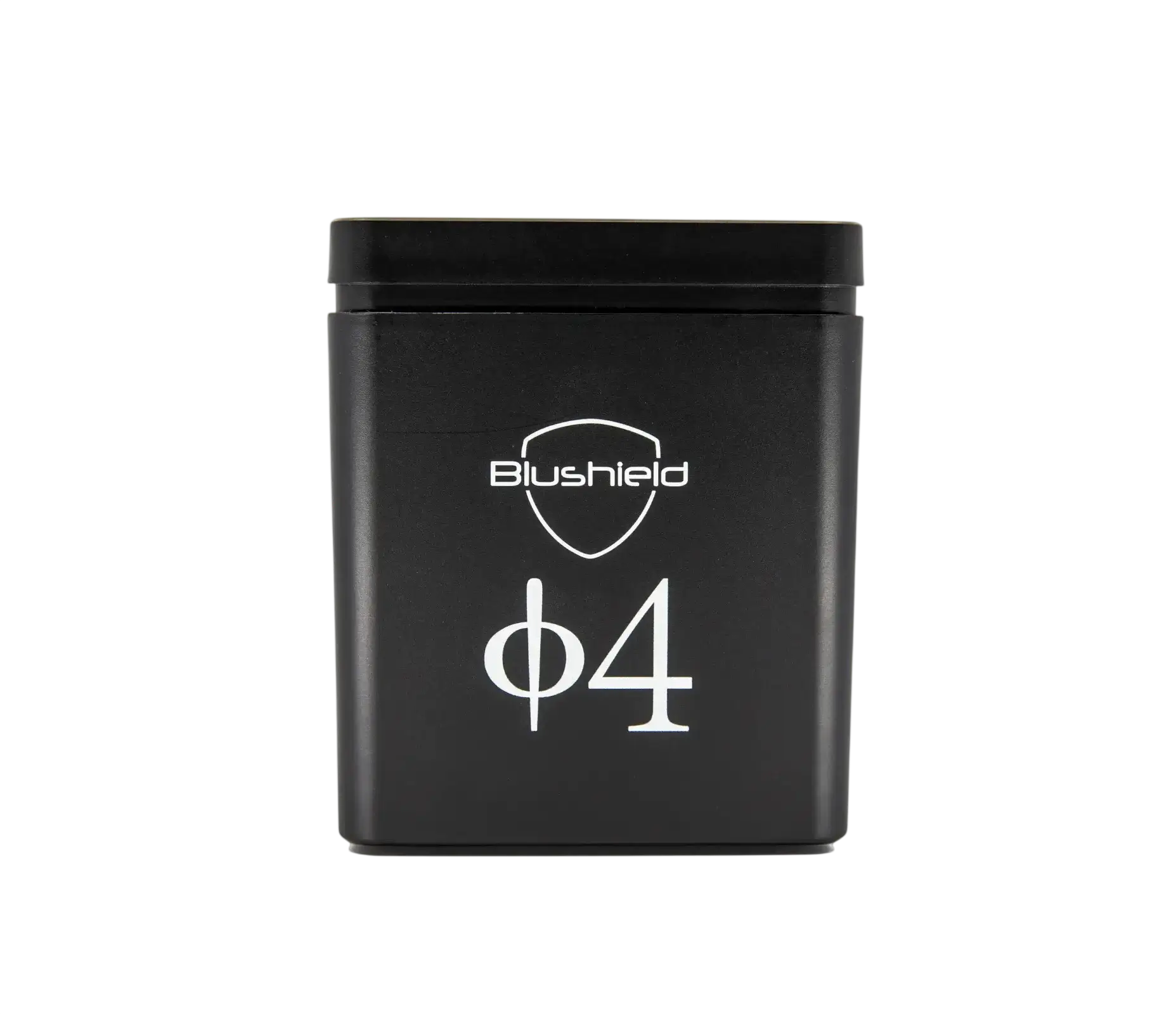
I have my Blushield in my pocket at all times, I wear a pair of boxers by a company called Lambs. They are phenomenal. I'll link to those in my show notes, too. They are to protect my goods from any type of cellular wave. Then I also, I'd be interested to hear your thoughts on this one, I do have a DefenderShield case on my phone, but I never keep my phone on me. If it's on me, it's on airplane mode, or if it's in the car with me, I'll put it away from my body. Do you have any thoughts on those cases, because I've always been skeptical of them, but I buy them anyway because I'm over-conscientious.
Brandon: Okay, so this opens up a real rabbit hole, which I love. It's fun. This gets a lot into theoretical physics, scalar, reality/non-reality. So you have ones that do actually block signal. You can take a trifield meter, or any sensitive equipment that can pick up and say, okay, either this dampens the field coming through, meaning the amplitude is not as strong, or it just completely blocks it, which is great. You think, okay, I'm protected.
I wrote an article called "Can You Actually Block EMF?" So here's the thing. All points in timespace are connected. We can take the strongest microscopes we have, and basically split apart atoms -- I mean, most reality is empty space. You can keep zooming in on reality to an almost infinitesimal degree, and you'll realize that there's not a lot of physical matter there. What's happening in nature, in reality, what we feel as solid, is actually just a lot of dynamic movement of energy.
So what happens when you have one of those things on your lap that you put your laptop on and it's blocking EMF -- you measure it with your tool, "Okay, I'm cool," or you have it on your cell phone -- is that the information, the scalar component, the non-physical, yin component to the yang force energy, is still present, and it just shifts into a different energy form. So what you'll notice is that you'll still get heat. If you hold that up to your head, you'll still feel a heating sensation. If you have one of those things on your lap with a laptop, those metal plates that are blocking EMF, you're still going to have the heat. The heat contains the information of the repetitive frequency, which affects the cellular biology just the same.
What's been studied is, okay, we can measure this and block it -- so I sleep in this mummy bag made of Faraday, like basically a Faraday cage, and I block myself from all of timespace, which you can't do, obviously... there's subatomic, superluminal energies that penetrate and carry information. Then you think you're protecting yourself, but what hasn't been done that I challenge people to do, and I'd love to do myself at some point, is have somebody sleep in the Faraday cage; put computers and routers and all this stuff around them, and do a 30-60 day trial. How does their blood look? How do they feel? Because you're actually not only blocking "bad" energy, you're also blocking beneficial energy. Unless you create a micro energetic ecosystem inside of that Faraday cage, it has a debilitating effect on cellular physiology as well.
It's a step in the right direction, as far as the idea. The scalar component of these energy fields is 5-6 times stronger than the actual Hertzian, measurable transverse wave. It's still debatable, and I've always been a fan over the years while I've been figuring this out, because I don't think anybody has a real, 100% "how do you protect yourself", because literally, everything is inefficient in nature. You're not going to get 100% protection. What we found with Blushield is it gives a 93% protection at the cellular level, at the mitochondrial level, through animal testing and human testing. But we don't have any real evidence as far as like, if you paint your house with certain materials that block transverse waves, Hertzian frequencies. There's no real long term data on that, as well, so it's kind of up in the air at this point. Can you block it? Well, it's debatable.
Jay: Super interesting. I think that is going to be the thing that distinguishes Blushield from other types of EMF mitigation. Other types of EMF mitigation, like you've mentioned, is all about blocking. All about seeing how can we keep this from talking to your biology, but what you're saying is that we may have a piece that's not communicating to our biology, but the aspects that we do need to speak to our biology, like if we're in a Faraday cage, aren't there. Or there could be other things that we can't necessarily measure, because we don't have the potential to do that now, that's speaking to our biology that could potentially have some negative effects. Am I hearing you right?
Brandon: Yeah, and we know for a fact the non-physical components, the informational fields that are piggybacked -- it's kind of like electricity and magnetism, for a long time people thought those were two different things, but then the Scottish scientist James Clerk Maxwell figured out you can't separate the two. He also theorized early on about scalar energy, or longitudinal waves, compressional waves that actually move in the same direction as the propagation of the field, which is different. Let's just say, you've seen those CrossFitters and they're doing the ropes, right? They put force into one end of the rope and it creates a ripple, kind of like a wave, that goes to the other end of the rope.
That's more or less what a transverse wave does when it's oscillating. But like an ocean wave, you have the top surface where the wave is kind of curling and crashing, but under the surface would be the longitudinal energy, that's that compression, that's what's pushing, creating the movement behind it. Anything in physics, the great thing about being a scientist if we're doing it right, and I'm not a scientist, obviously, I just work with them, is that we make mistakes. We figure out where we're wrong, we improve, and we get a better understanding.
A great example of this, which actually kind of correlates with scalar energy, this type of longitudinal energy, is black holes. For a long time, we had hypotheses of black holes. We kind of knew the energy potential, and for people that don't know what a black hole is, it's simply an unstable chemistry of the atoms to where the... okay, I won't get into the electrical phenomenon of it, because that's way too technical. But essentially what it's doing is it's collapsing energy into an infinitesimally small point. It's creating this vacuum where everything is kind of getting sucked into this extremely small point in timespace. Just in recent years, the last 10 years or so, we've proved these actually exist because we have technology that can verify and quantify that. But we've known about them, or the idea of them, I should say, for a very long time. What happens when that black hole collapses is it creates a longitudinal wave that goes throughout the galaxies.
Many people -- and this is completely hypothesis, just ideas, so take this with a grain of salt -- but a lot of people on the cutting edge of understandings of superluminal energies, the subatomic realms, essentially, think that these black holes are essentially necessary for charging... if you think about all the planets, galaxies, suns, everything that's out there as cells in the body, the black hole would be the thing that disperses a longitudinal wave to charge those planets, cells, suns, with energy. That's obviously a hypothesis, but it correlates with what we learn in Chinese medicine about yin and yang theory, and the five elements. You have something which is yin, which is the storage and accumulation of energy, and then you have the yang, which is the manifest, expressed. So you have unmanifest and manifest.
You see these principles all throughout nature, like you have an idea, right? Yeah, there's a little bit of electrical synapses that happen in the brain if you're on a EEG machine, but the consciousness that motivated that idea is unmanifest, right? You can't quantify it, you can't burn it, stamp it, put it under a microscope, and quantify it in any way, because thoughts are superluminal energy as well. But that energy can manifest into your action, which you do in real, 3D timespace. When we're talking about scalar, we're talking about fourth dimensional, compressional, longitudinal energy.
That's something you can only really see in biological systems. That's why when we test Blushield, we have to do it on animals and people, we have to look at how it affects water and how it affects living systems, because it's 1.5 times the speed of light. You can't stop it or slow it down enough to really study it in the traditional reductionist scientific method.
Jay: Yeah, interesting stuff. For any of my listeners, if you're like, "Whoa, this is mind blowing, I don't know what to do with this," we're going to break it down for you, super simple. So it's always fun to get into the science, the theory, the quantum biology, but I do understand that some of this can be quite difficult to wrap our heads around. We're going to do our best job to talk about this idea of longitudinal components, or scalar components, and talk about what it does and why we would actually like to utilize something like that for mitigating the exposure we have to EMF.
So we've come to this point now where we've identified what EMF is, we've identified that blocking, or trying to completely block EMF, may not be the most effective or even the best thing for us. That brings us to where Blushield comes in, and where scalar technology comes in. I know you've gone ahead and utilized the terms longitudinal components or scalar components and transverse waves, so let's see if we can break down in its most simple components, even though I know that's quite a task and not easy to do! What is scalar technology? If you had to summarize it in a very simple way, how would you give your elevator pitch on scalar?
Brandon: Ooh, yeah, there's really no elevator pitch. It becomes a little bit tricky, in a sense, because there are so many words that often refer to scalar energy in different ways. So you have zero point energy, the classic standing waves or Tesla waves, which are more of the classical, scientific way to say it. You also have Tachyon, you have orgone, you have radiant energy. All these things refer to the same energy. Essentially, at its core, if you neutralize all electromagnetic frequencies -- let's say you had a way to make them disappear -- you wouldn't hit a net zero. There's not "not energy" in the universe. So even if you take all of what we know away, there's still a standing field, or a gravitational wave, a gravitic wave.
Essentially what scalar technology does, and most of them are still kind of old school compared to what we've done with Blushield using crystal photonics – they use radiofrequencies, you can use any type of magnetic field, radiofrequency, there's different ways to create scalar. But what you're doing is you're creating a neutralized field. A lot of companies are still doing these, phasing these 45 to 90 degrees, to 180 degrees out of phase with each other, and what you're doing is creating a neutralized field. That creates a field that, if you can visualize this in your mind's eye, it's like a circle, or sphere I should say... imagine a sphere and that sphere expands in all directions, or omni-directionally, and it collapses back in on itself. That's what's happening with these different ways of using high-voltage, or low-voltage, or however people are doing it these days, to create a scalar wave.
Scalar, in and of itself, isn't good or bad. We show clear evidence that it increases the zeta potential and the vitality of the cell, blood looks way better in the presence of it, but in Blushield we use it as a carrier signal, because what's really great is these longitudinal scalar waves don't lose power over timespace. If you have a transverse, Hertzian frequency like with a cell phone, the reason we have to have repeaters is that it loses power over distance. With modern technology, distance is your friend. The further away from it you are, the less power it has, and influence on cellular coherence it has.
What's nice about Blushield is you can put this in the center of your house and it will go through walls, concrete, wood, metal in your house, and it doesn't matter if you're two feet away from it or twenty feet away from it, it's going to have the same intensity, because it doesn't lose power over timespace. It's moving through the subatomic structures between atoms, right? So it's going straight through the physical matter with the same level of intensity, and there's no distortion of the information on that longitudinal wave. That's not really a simple way of saying it, but basically, it's 4D.
So we have 3-dimensional space, which is measurable on the electromagnetic spectrum, and then the longitudinal component, which does not usually exist in 3D space... and we can't create it, by the way. That's another misnomer about scalar, is we're not actually creating scalar out of anything. We're basically amplifying this naturally occurring scalar that exists in all things, and we're amplifying it, essentially. So that scalar or longitudinal wave moves along the axis of time itself, in the 4th dimension. Which sounds completely weird and mysterious, and pretty woo without having a deeper understanding of quantum mechanics. It's simply compressed energy to the factor of the speed of light, squared, if you want a mathematical description.
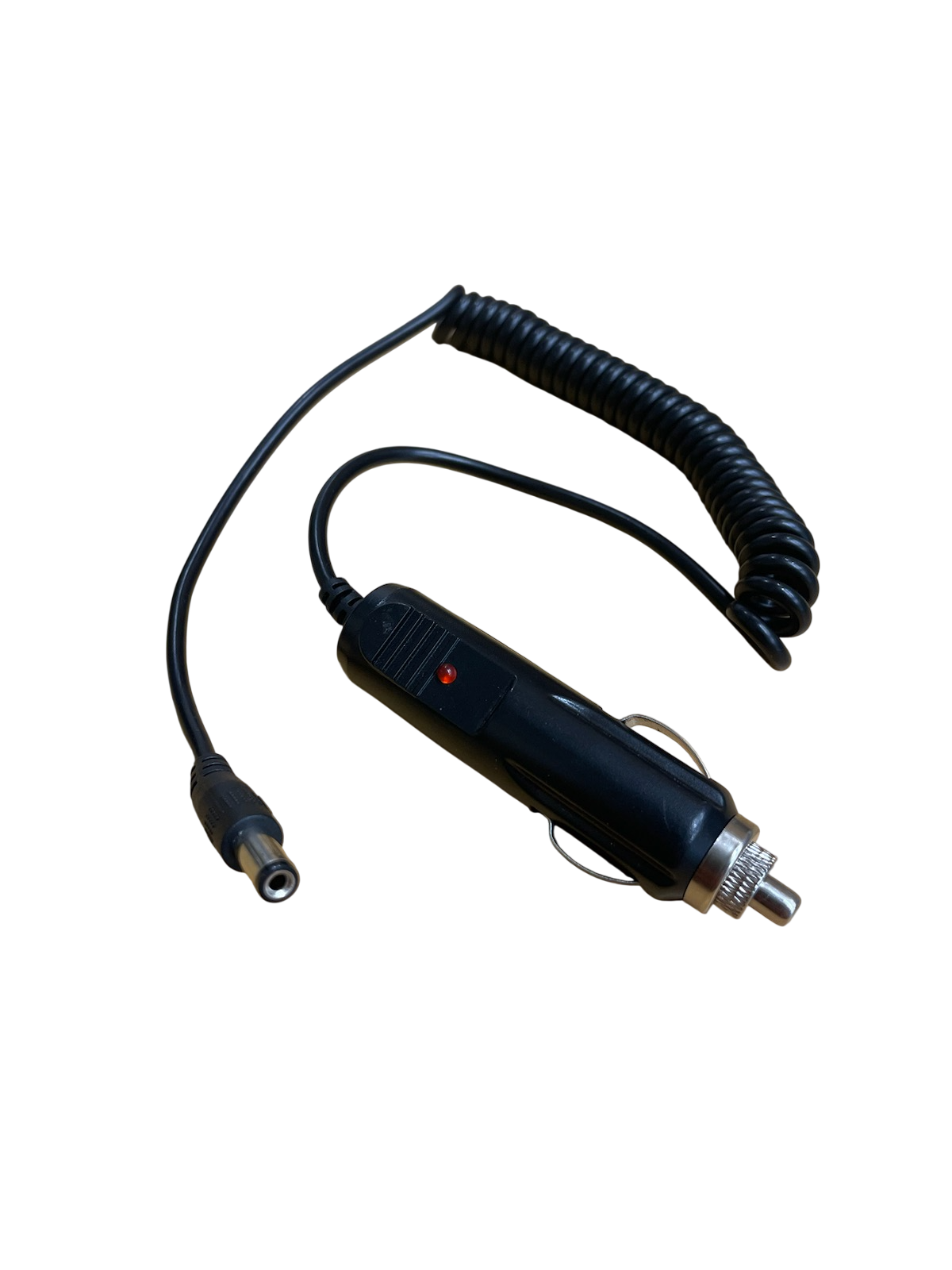
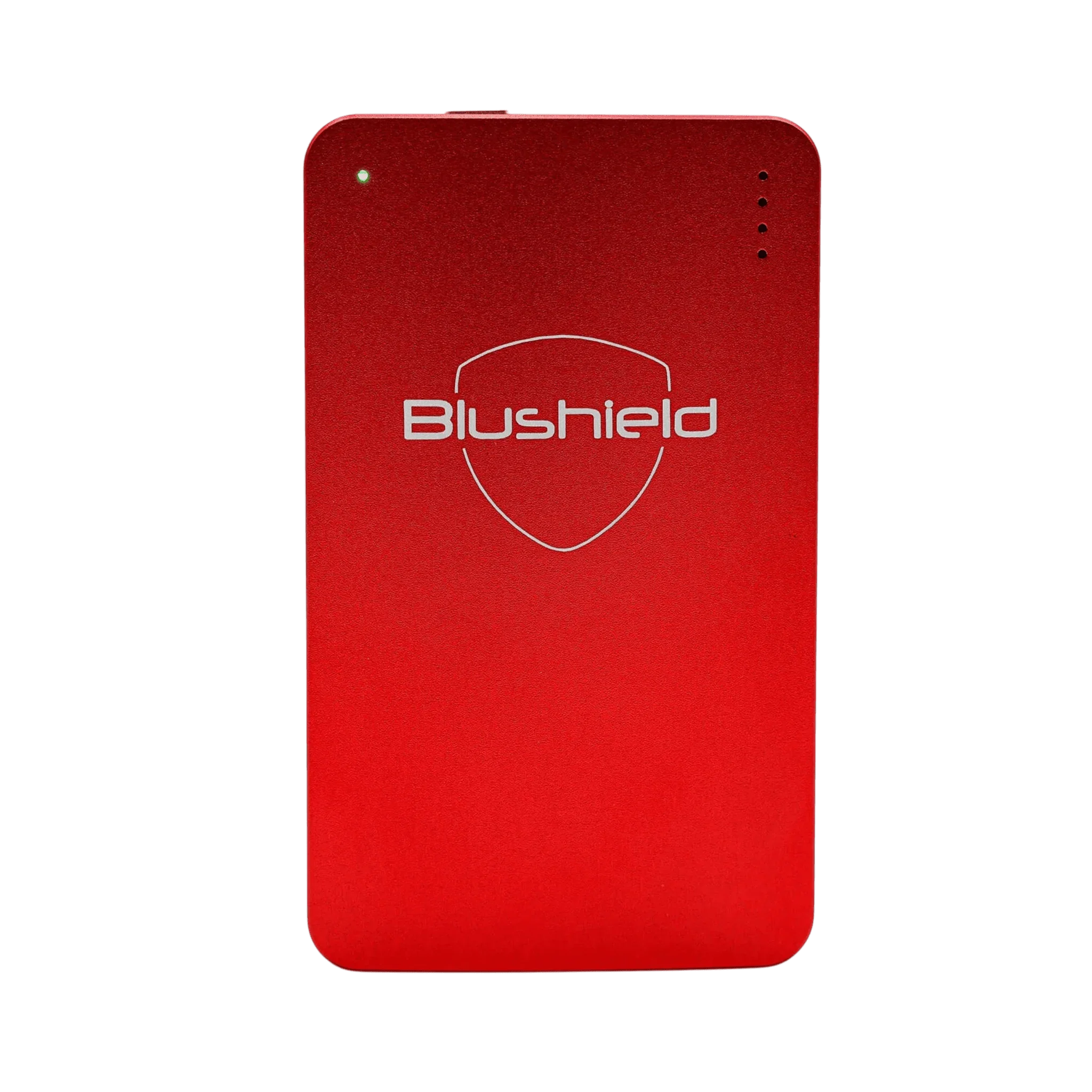
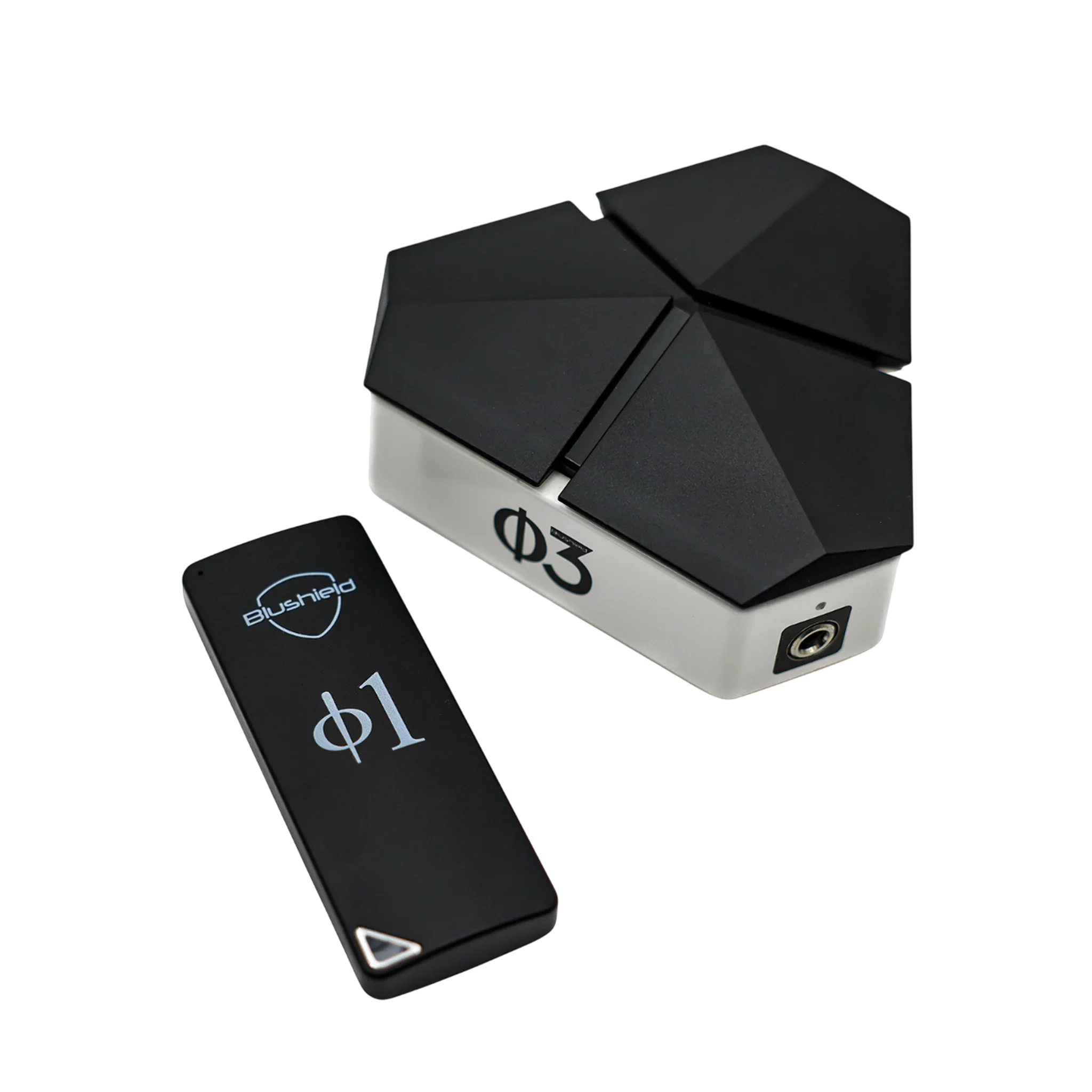
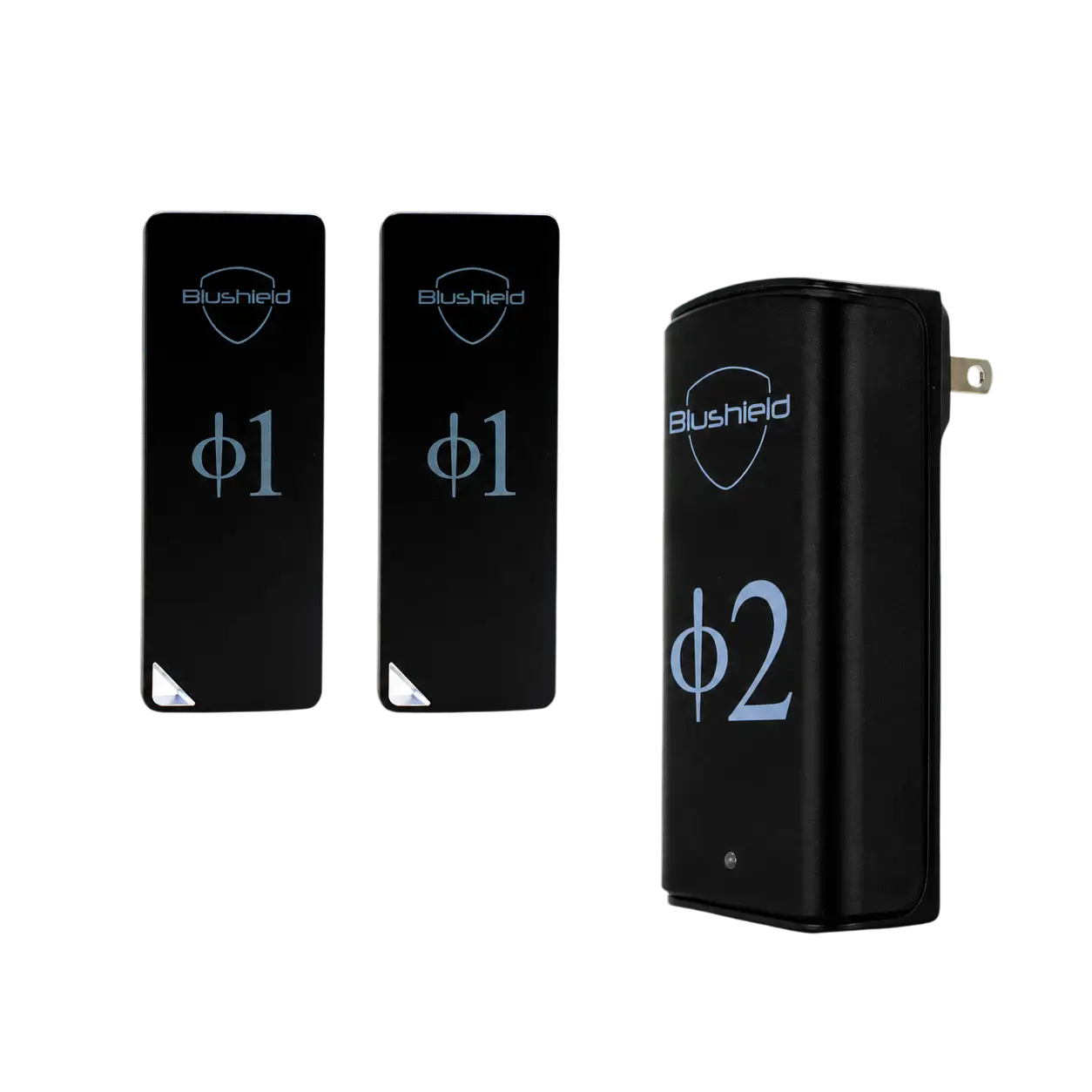
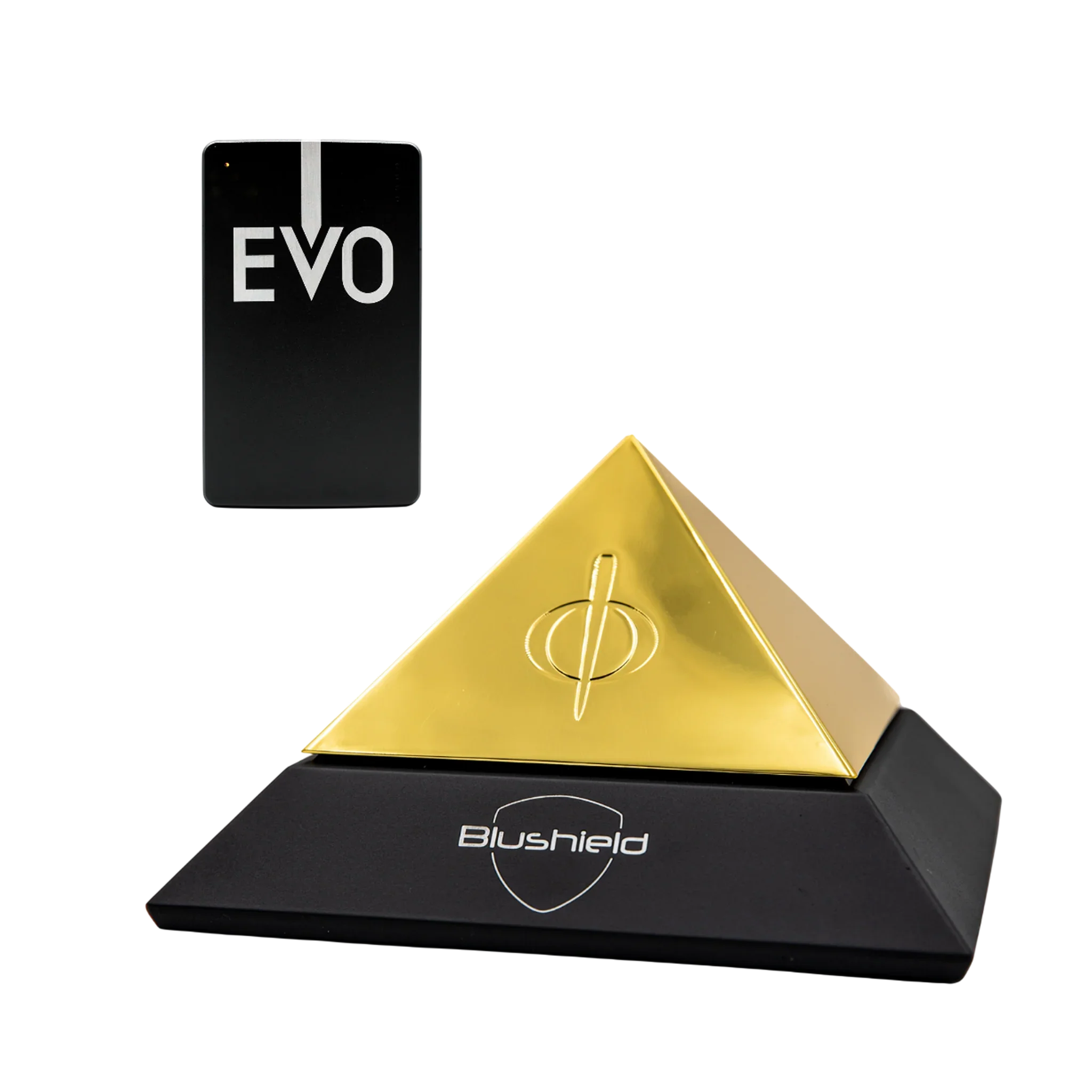
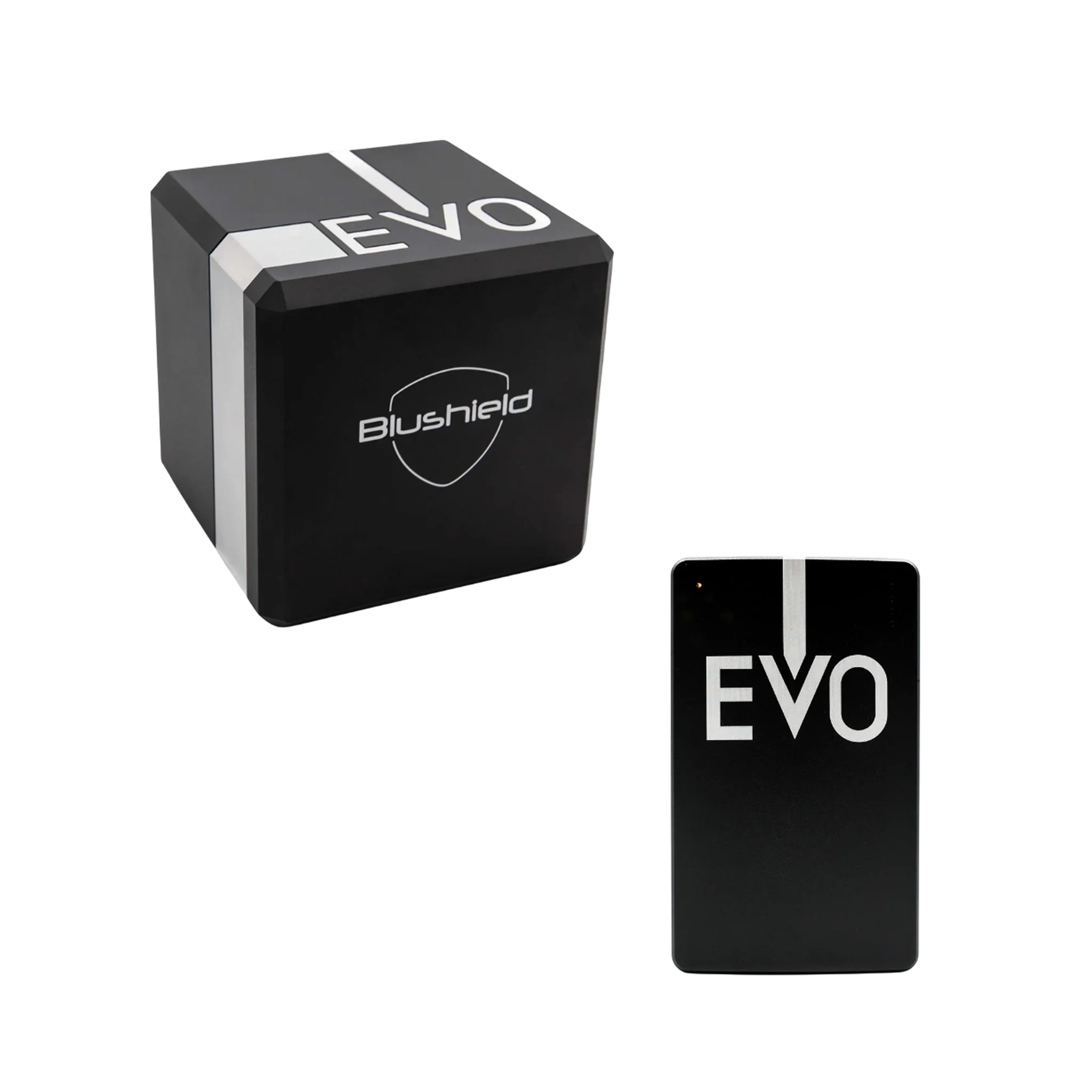
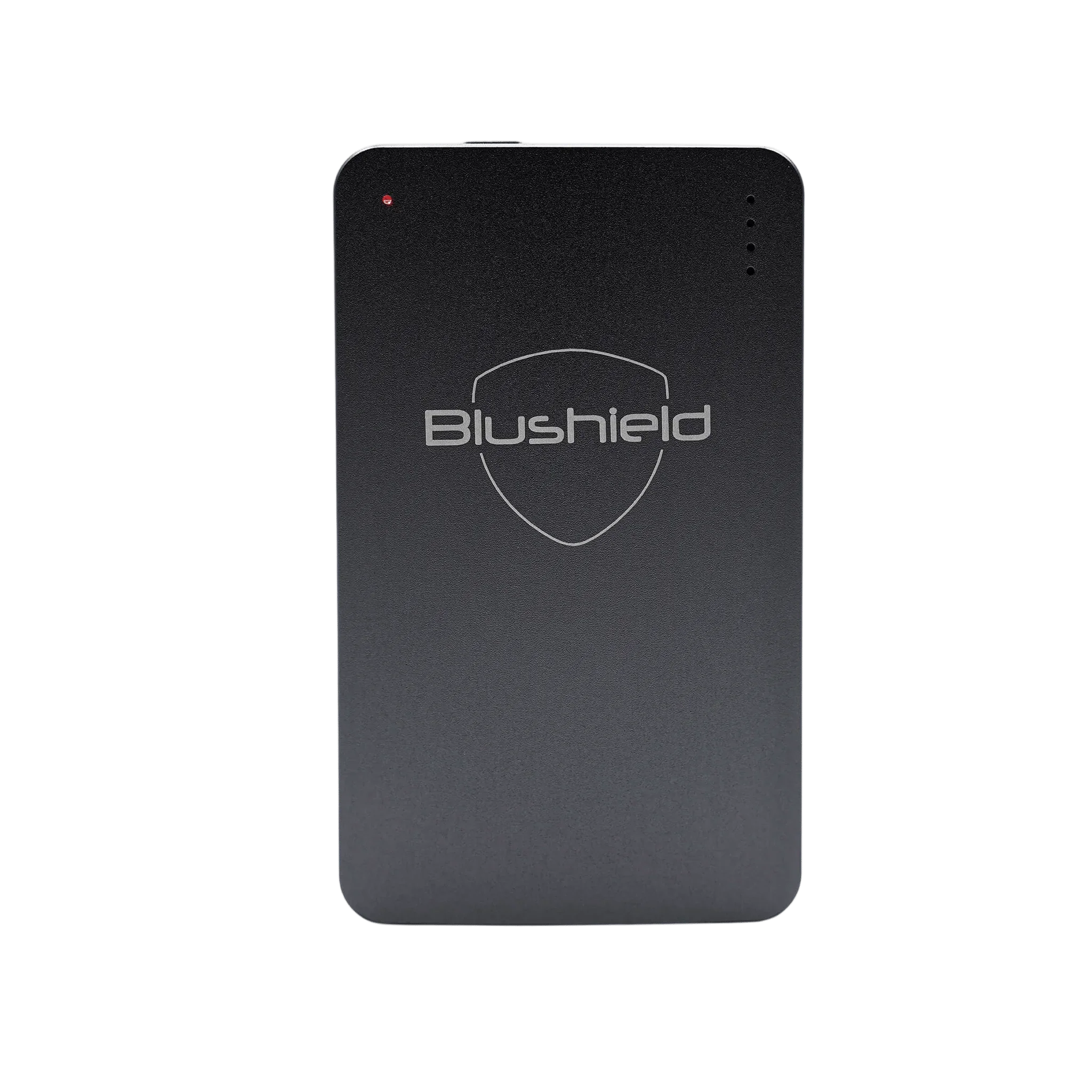
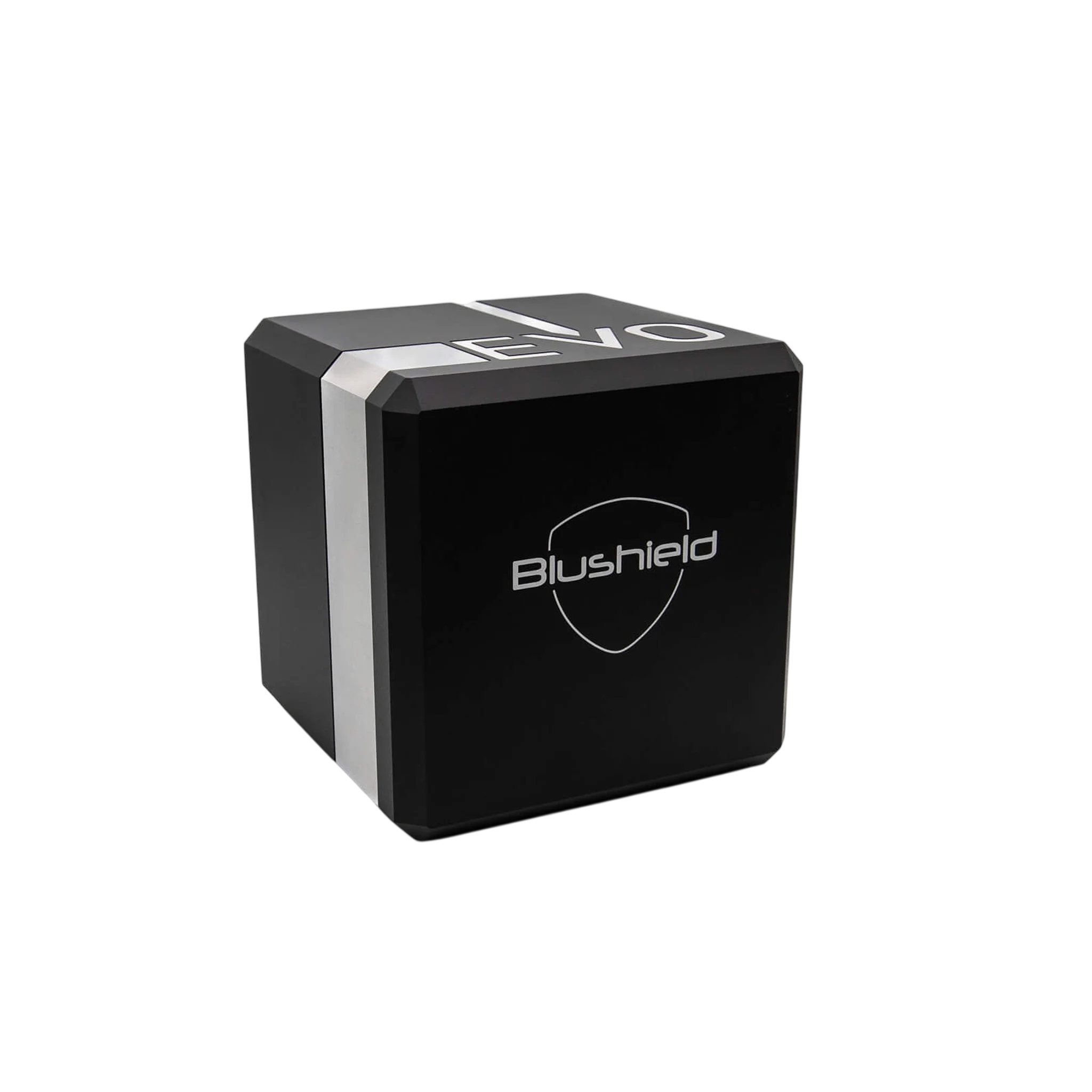
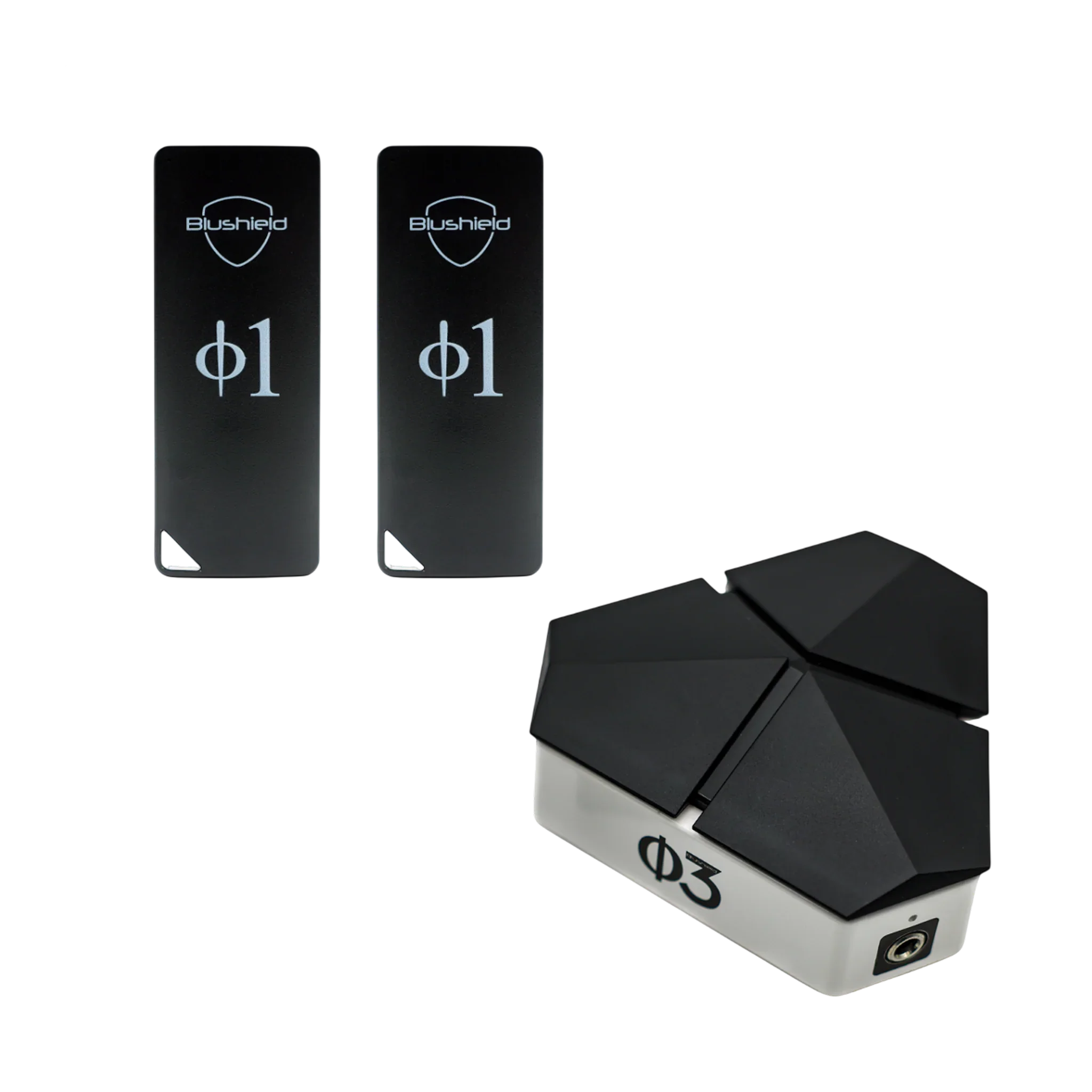
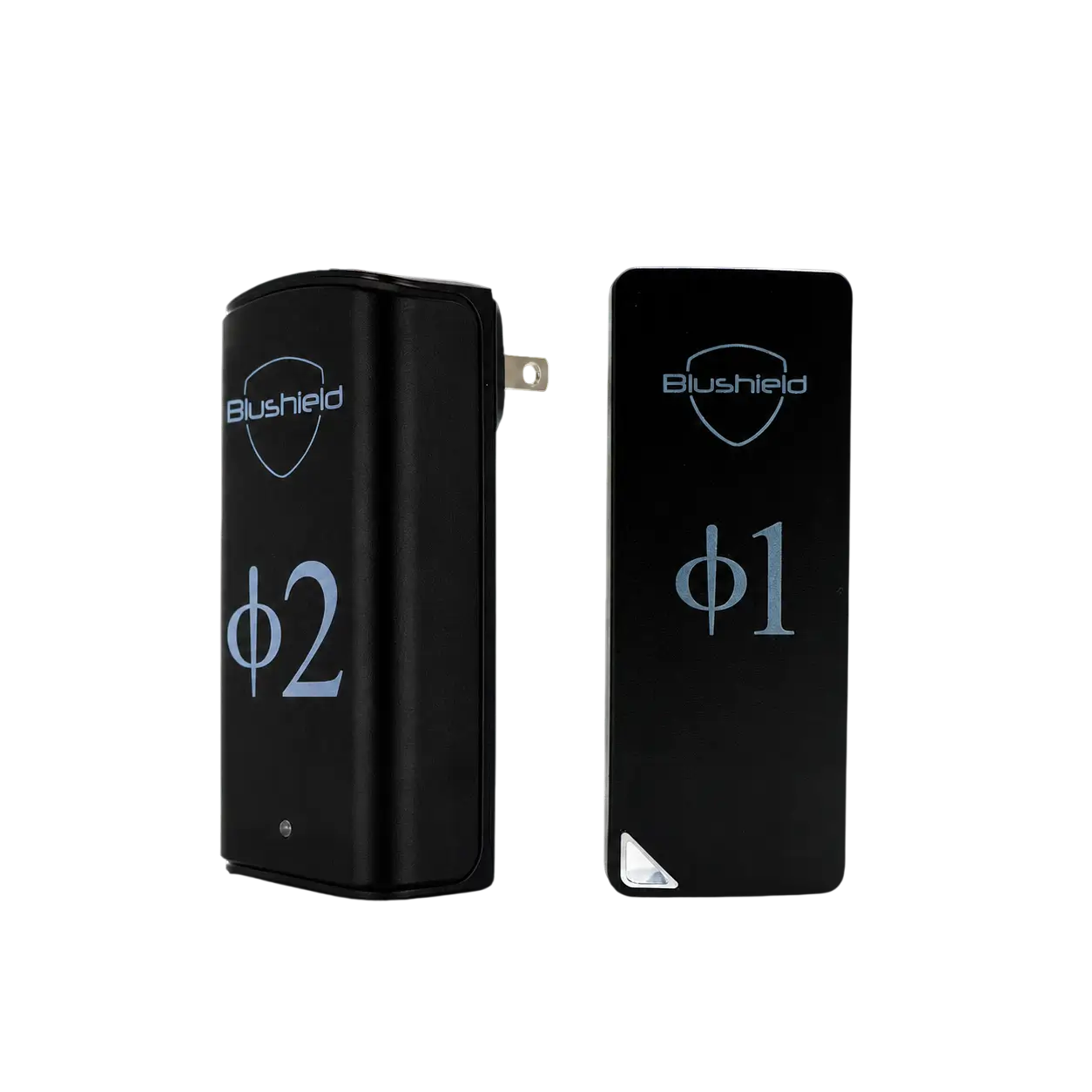
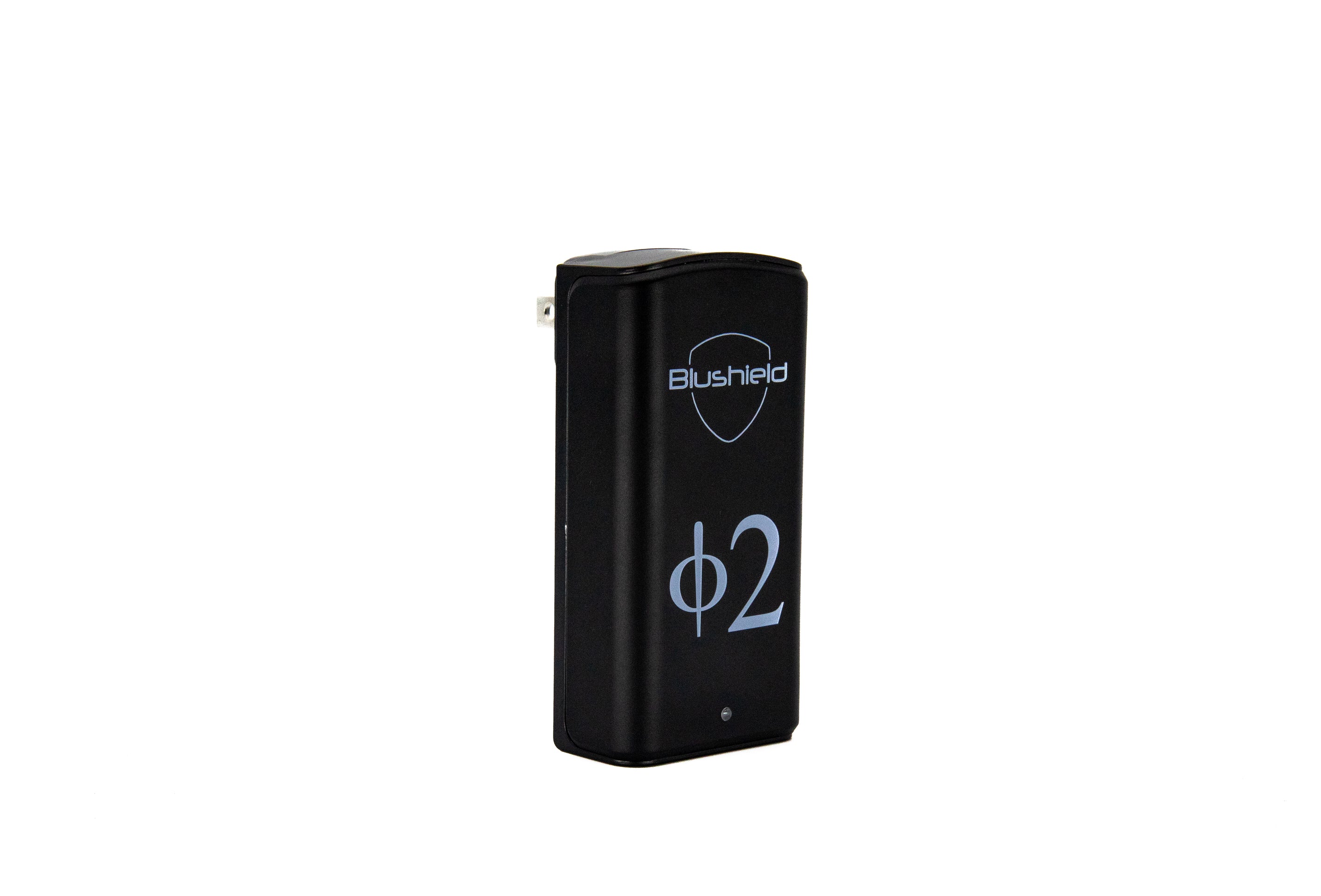
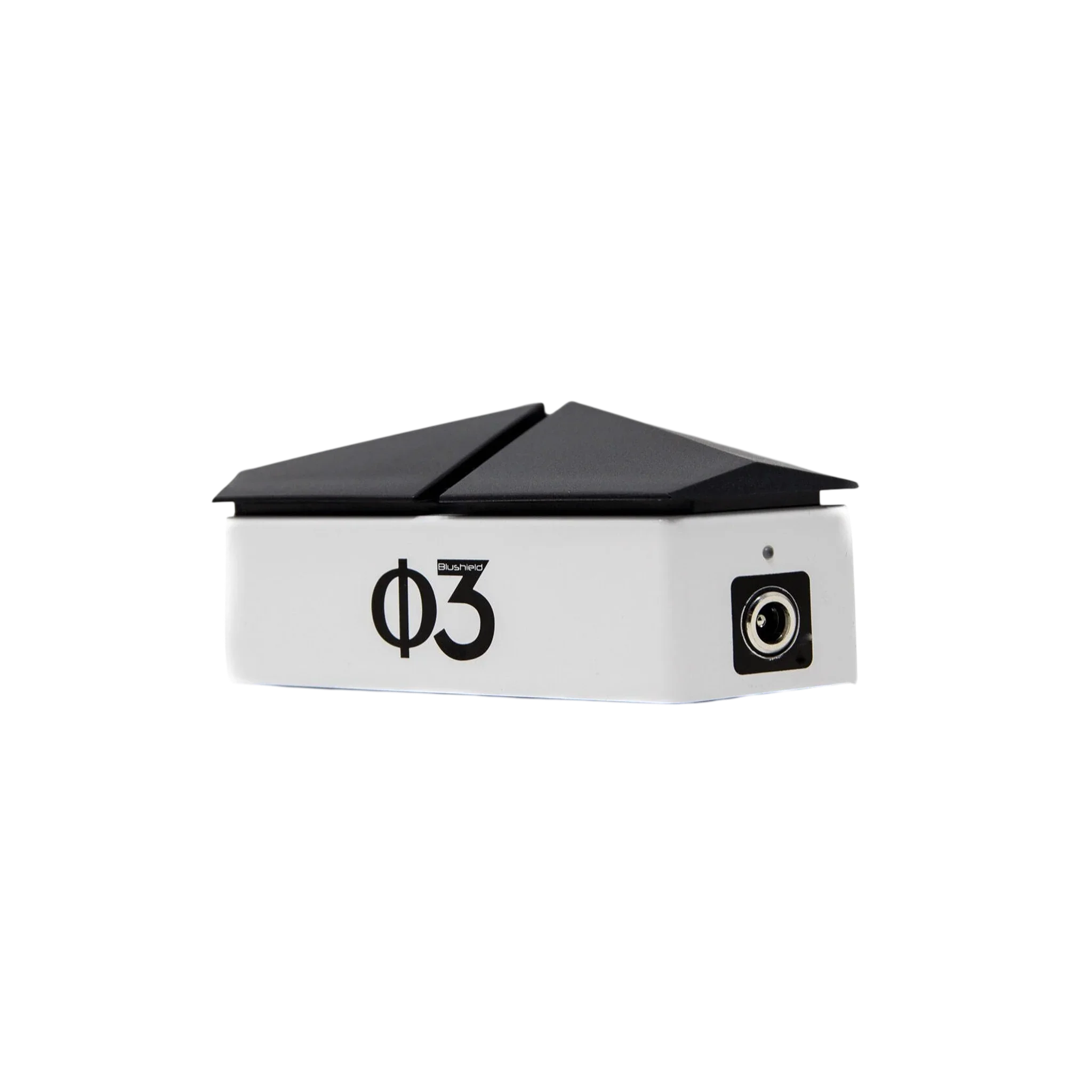
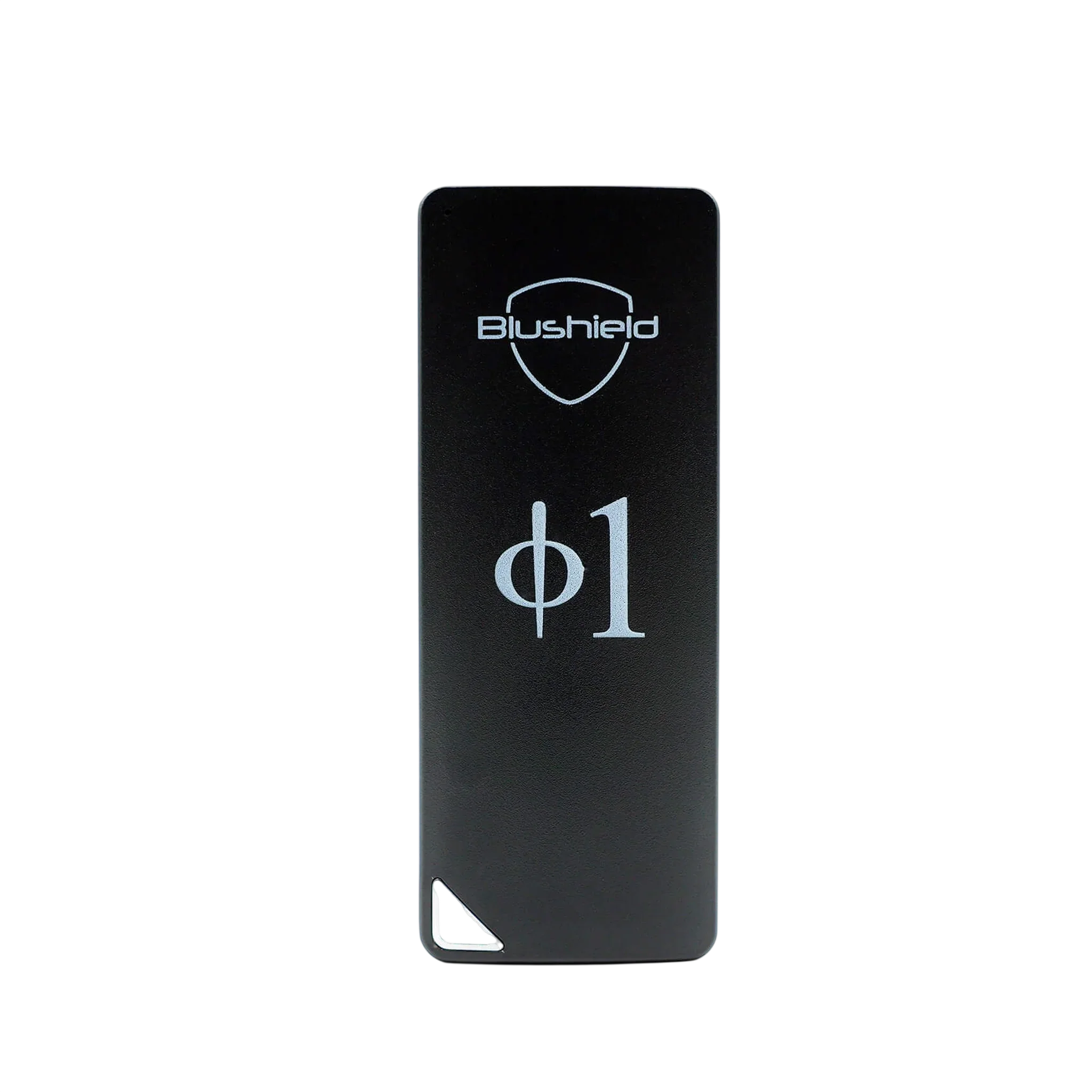
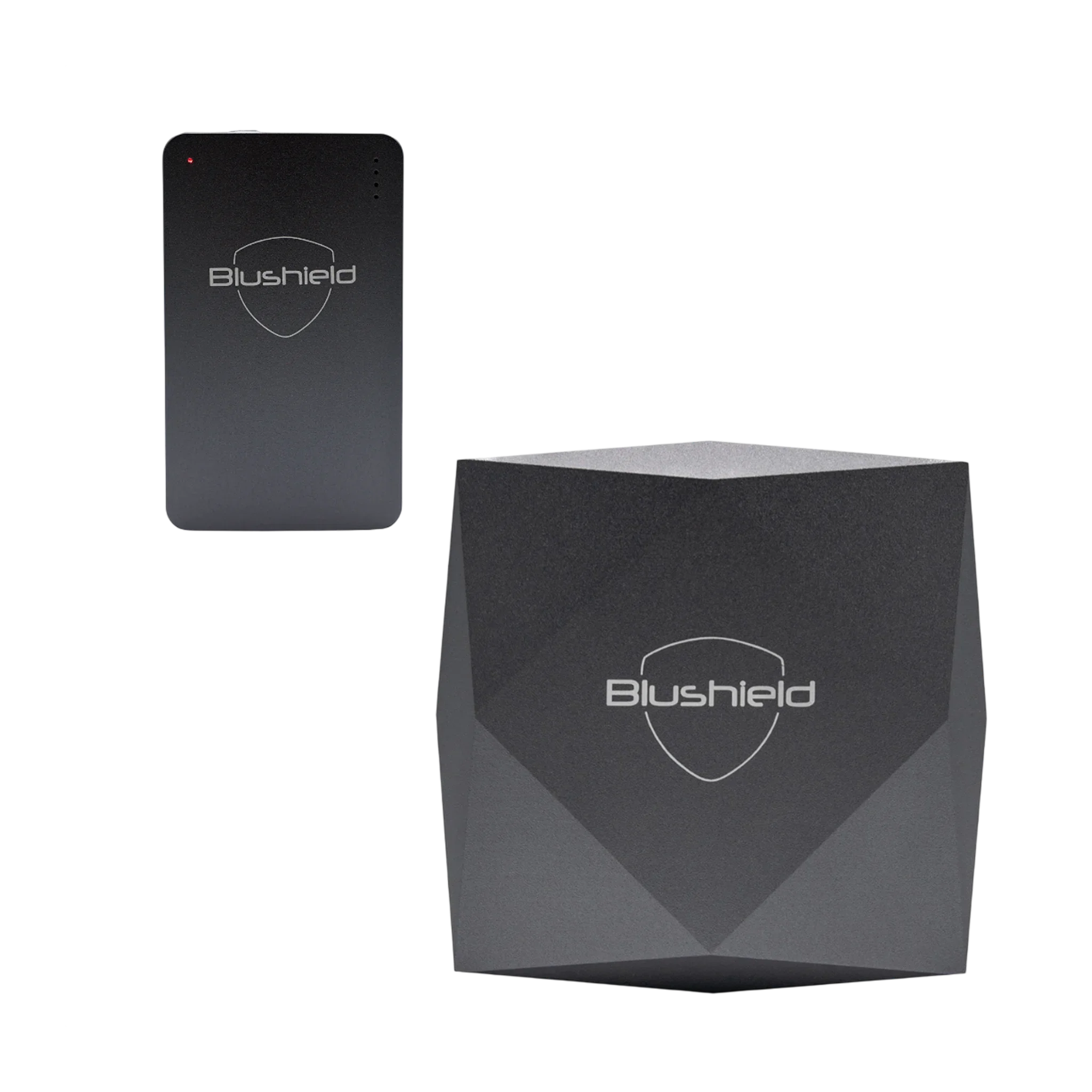
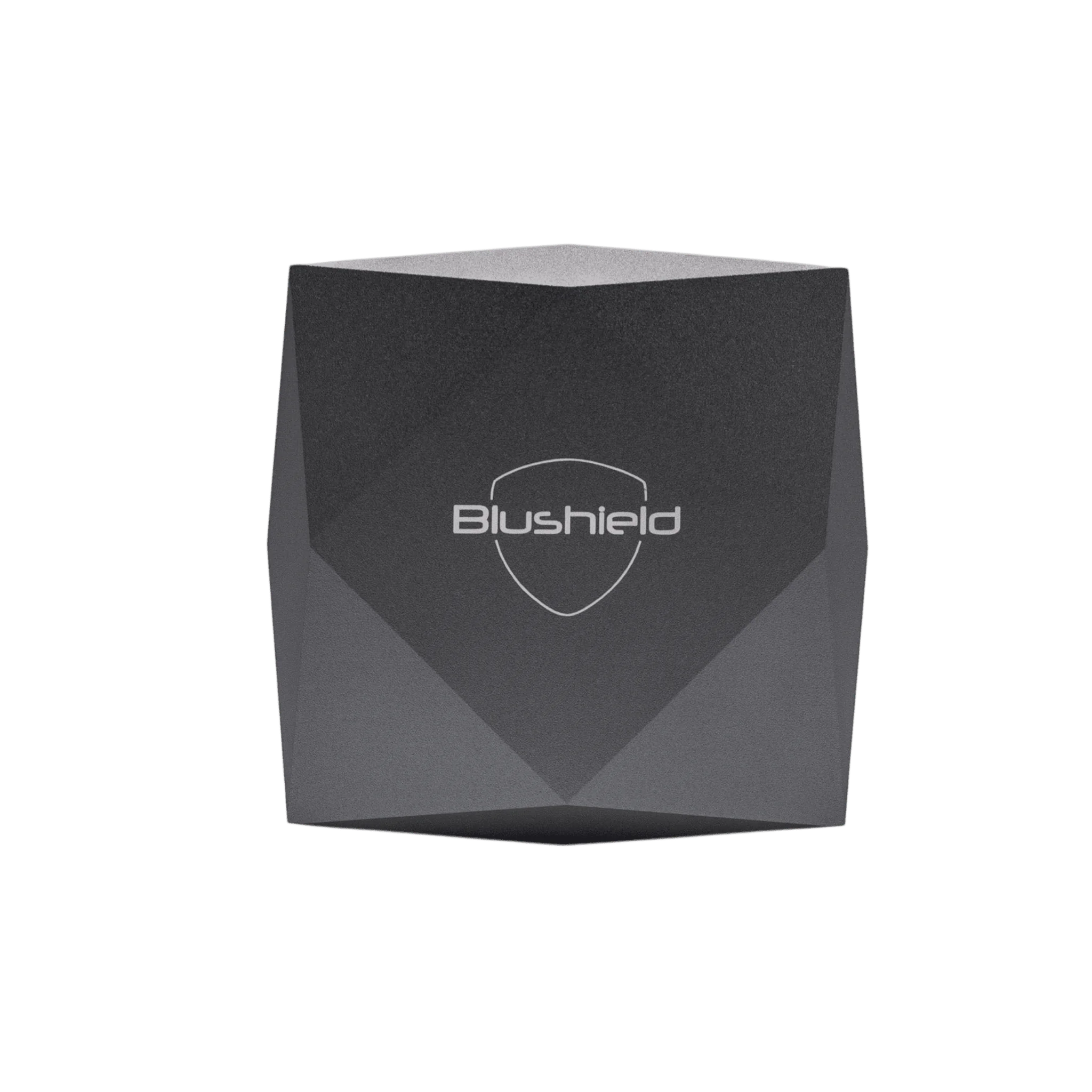
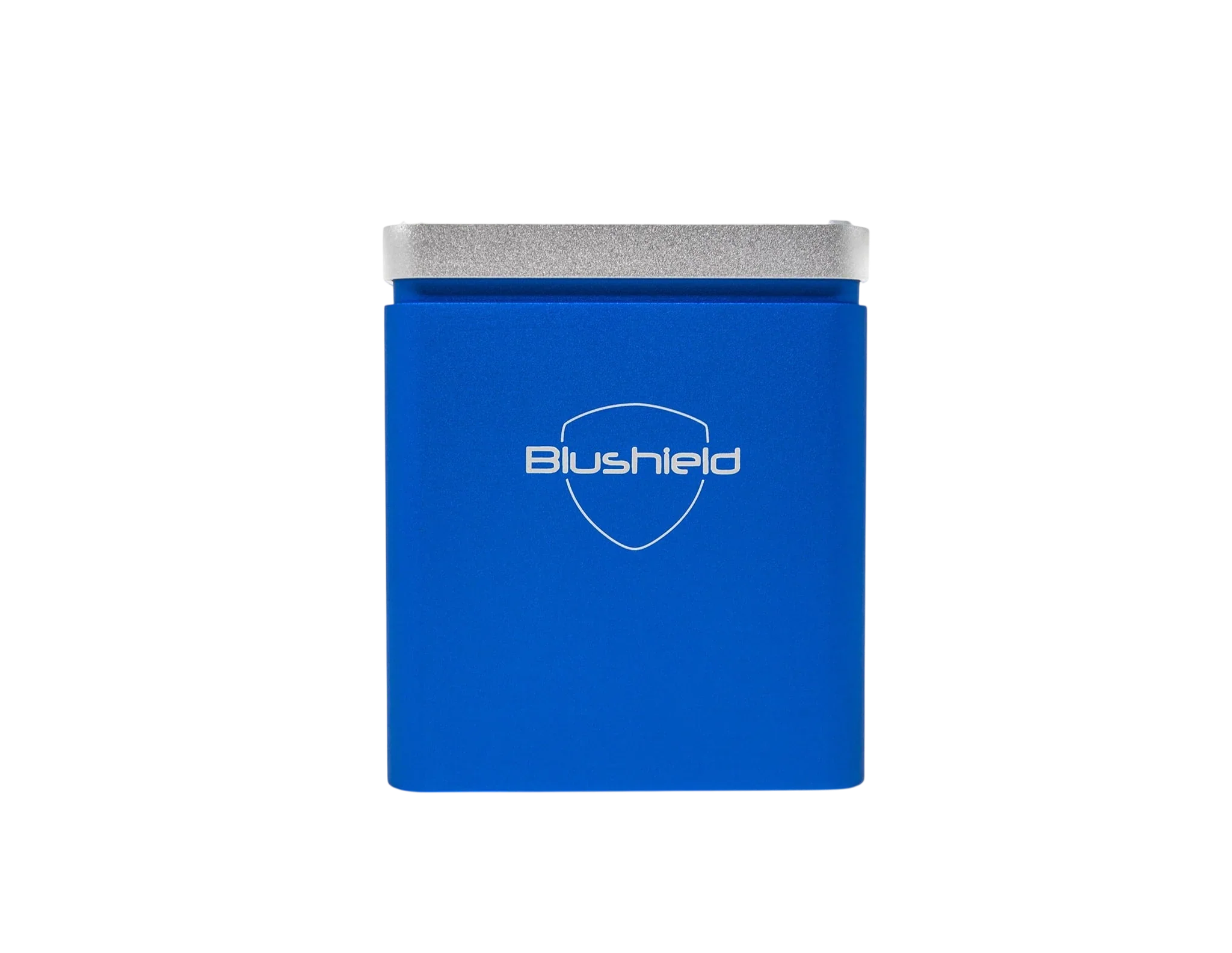
Jay: Yeah, that's easy enough, right? *laughs* A lot of my listeners are probably going to want to know: okay, let's say I go out and buy a Blushield device, whether it's a Cube or one of the Portable devices, or the one that goes in the car. So is it now amplifying this scalar signal so that the body is listening to the scalar waves and not listening to all the EMF around us? Is that an over-simplistic way of looking at this?
Brandon: No, actually, simplicity there is pretty appropriate. It's no different than tuning the dial on your AM or FM radio. We're resonant beings, so the body is most influenced by the strongest signal in the environment. At the cell level, what's happening is if you can imagine all these cells having antennas, or being tuning forks, when you dial your radio, like on an FM station, you're basically twisting a coil, essentially. What's happening is it's picking up different bandwidths of carrier signals, and when you dial it into a resonant frequency, you'll get a clear transmission of one of the carrier signals that has your favorite song on it. It doesn't mean that the other stations aren't bouncing around the airwaves. They're certainly there! But you're making a coherent audio sound that you can follow with your song, by tuning the dial into that.
What Blushield is essentially doing is it's transmitting signals that are strong enough to compete with the EMF in the environment, and over a ten to fourteen day acclimation period, your body starts to sympathetically resonate with it. See, Blushield isn't on all the time. It pulses a 3-second pulse every half minute. The longer you're exposed to that, especially the home units, which your body does the main entrainment with, your body starts seeking out those signals in the environment, and what happens is the body stops perceiving the EMF as a threat. It stops mounting an immune response, and it reallocates the immune power back to the body to regulate and balance itself. Your body knows how to heal itself, and I'm sure you know better than anybody, it's the lack of movement, lack of proper nutrition and hydration, and all these other things that really stand in our way. People just don't get that there's an electromagnetic component to that, and they might be doing everything else right, but if they're not protecting themselves at the cell level from EMF, that could be hindering a lot of the results they could be getting, potentially.
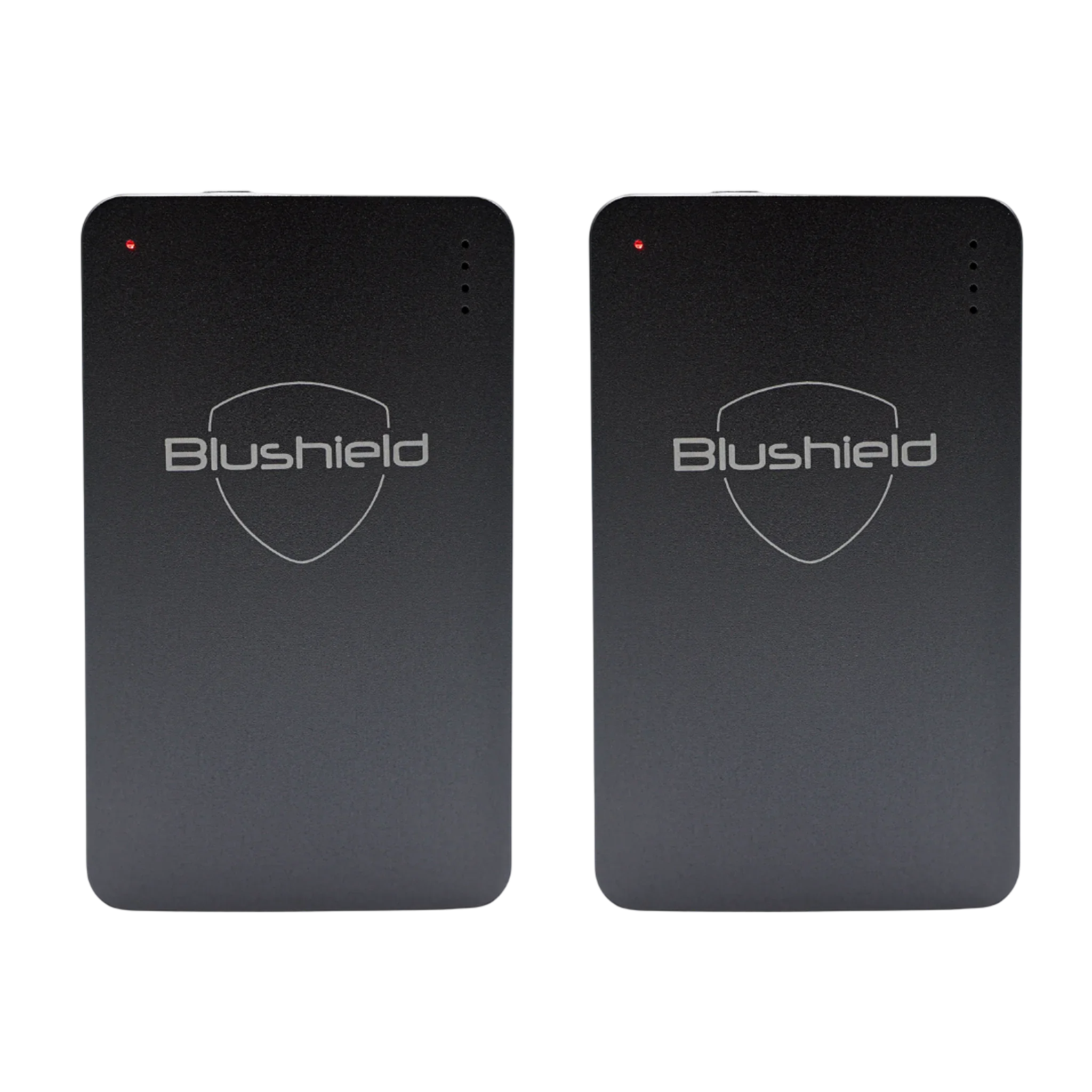
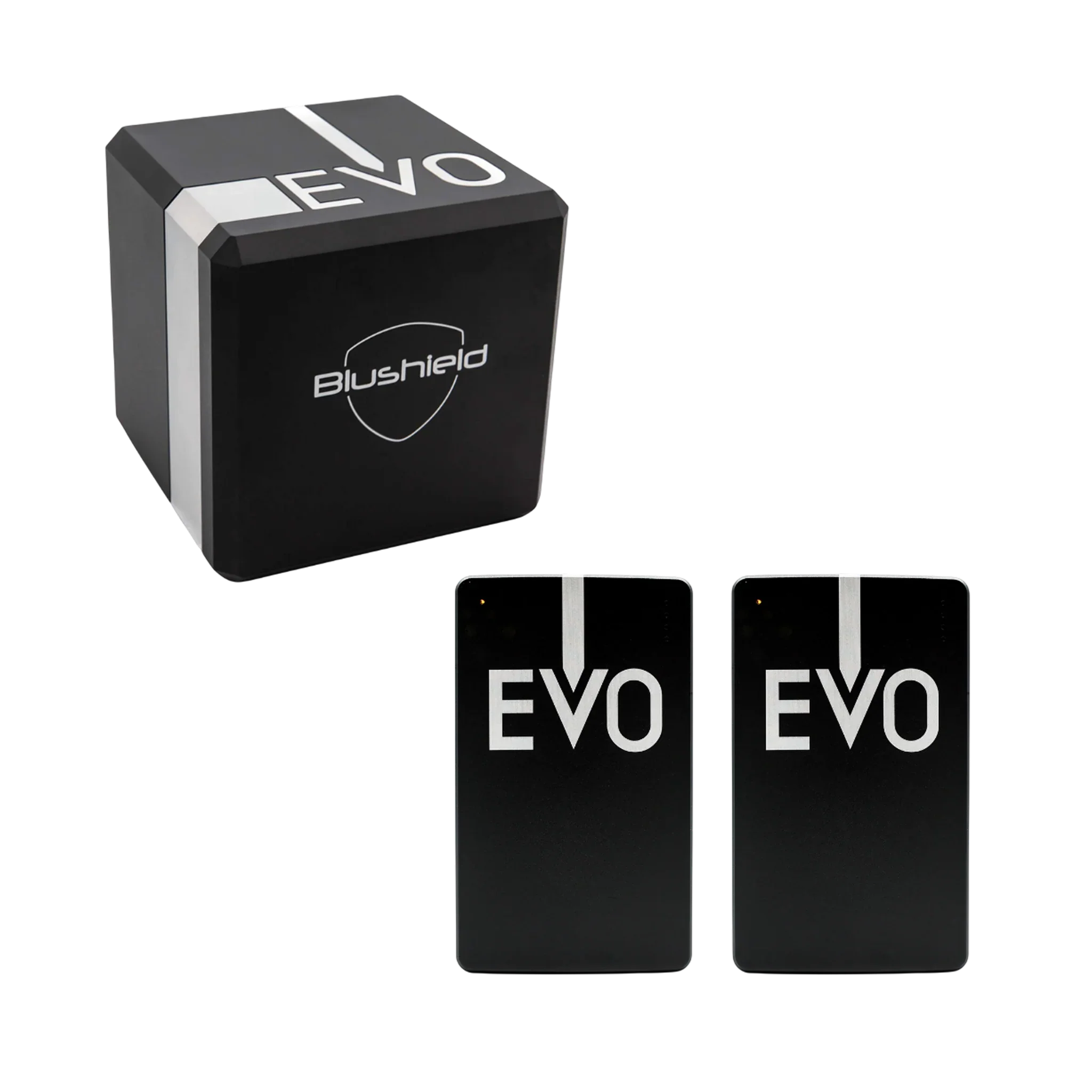
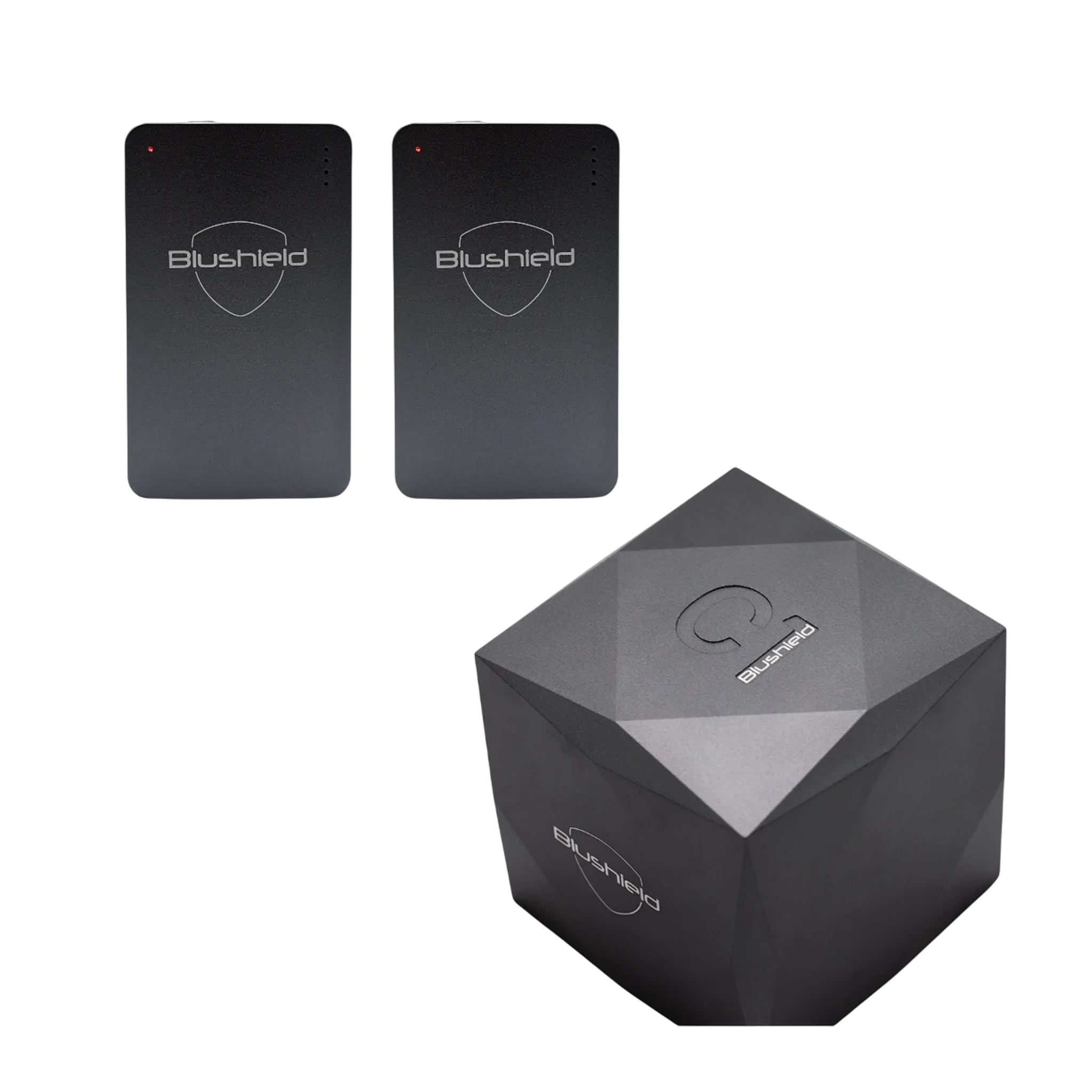
Jay: Good point. So I have two different units that I've been using, for close to two months now. I have the Cube, which is your home unit you've been mentioning, and I also have the Portable unit that I turn on and carry with me anytime I'm outside my home and not around my unit. You're right, when I turn on the Portable unit, and then the other unit is in my bedroom where I sleep... and I'll talk a little bit about my experience here in just a few minutes, but one of the things that you notice when you turn it on is there's a small light that blinks really fast, and it pulses, and every 30 seconds or so it does it again. What does that flashing light indicate? Is that something that's actually happening in that moment?
Brandon: Yes, absolutely. We use a microprocessing technology, which has all the complex layer of algorithmic code in it. There's multiple waveforms being generated, and they're at different degrees out of phase with each other to create the desired effect. If you understand how LEDs work, and the anatomy of LED with the little microcrystals in it, and you understand how to use electrons to step up and step down voltage in a way where you can create the carrier signal and then imprint the information, which is really the magic -- I mean, the scalar technology, as far as how they developed it, is kind of revolutionary.
Ever since James Clerk Maxwell's days, to Tesla, to modern people experimenting and evolving the understanding of the superluminal energy, they just realized, hey, we don't need high voltage anymore, like Tesla was using. We don't need coils. In fact, you're going to piggyback a lot of stuff you don't want onto a scalar field, because it's an informational field, right? So if you have the information of copper always being embedded onto that signal that's pulsing out, that's problematic because there's all these mineral marriages in the body, which you know, if you have too much copper in your body, your body is depleted in zinc. If you have too much zinc, you need copper, so on and so forth.
Using light, we found that to be the cleanest way to do it. The LEDs just facilitate that code perfectly. What's happening, to answer your question more directly, is that we're getting power through the grid, we're putting it through the microprocessor, which commands all the code through light signaling. The thing is, with the scalar wave, your body doesn't have to be exposed to the light. Meaning you don't have to have this as a photobiomodulation onto your skin to get the benefits, because the longitudinal wave transcends timespace, so it will go right through all of that stuff. The light just facilitates the signal transmission, which communicates with your body, which gives you the benefits.
Jay: Interesting! I did not realize that. I thought it was just kind of like, evidence of hey, this thing's on.
Brandon: Nope. It's not on all the time, and you wouldn't want it on all the time, because it's the on/off, it's the changing, it's balancing in the algorithm the two properties of coherence and randomization, which you need. You need the change-up, you need the oscillating amplitudes, you need a lot of things happening. That's why the code is so extremely complex. We get people, still to this day, all the time, people trying to figure out how we're doing it... I wish I was at liberty to discuss more of that, it's very proprietary.
Jay: *laughs* Give us your secrets, man!
Brandon: I know! When you look at any EMF protection device on the market, they might be using three or four frequencies, but they're still having the same repetition. Or you get white noise generators, essentially. It's just creating a lot of random frequencies, so it's kind of like a smokescreen, you know, it's not really doing anything at the cellular level to get your body to stop fighting the EMF. A lot of those products tend to wear out, depending on how complex their code is, they have different ranges of effectiveness. We wanted to create something that works for everybody all the time, that has long-term benefits, that really won't repeat itself for generations. You pass these down to your kids, and they won't experience the same combination of frequencies twice, just like you didn't.
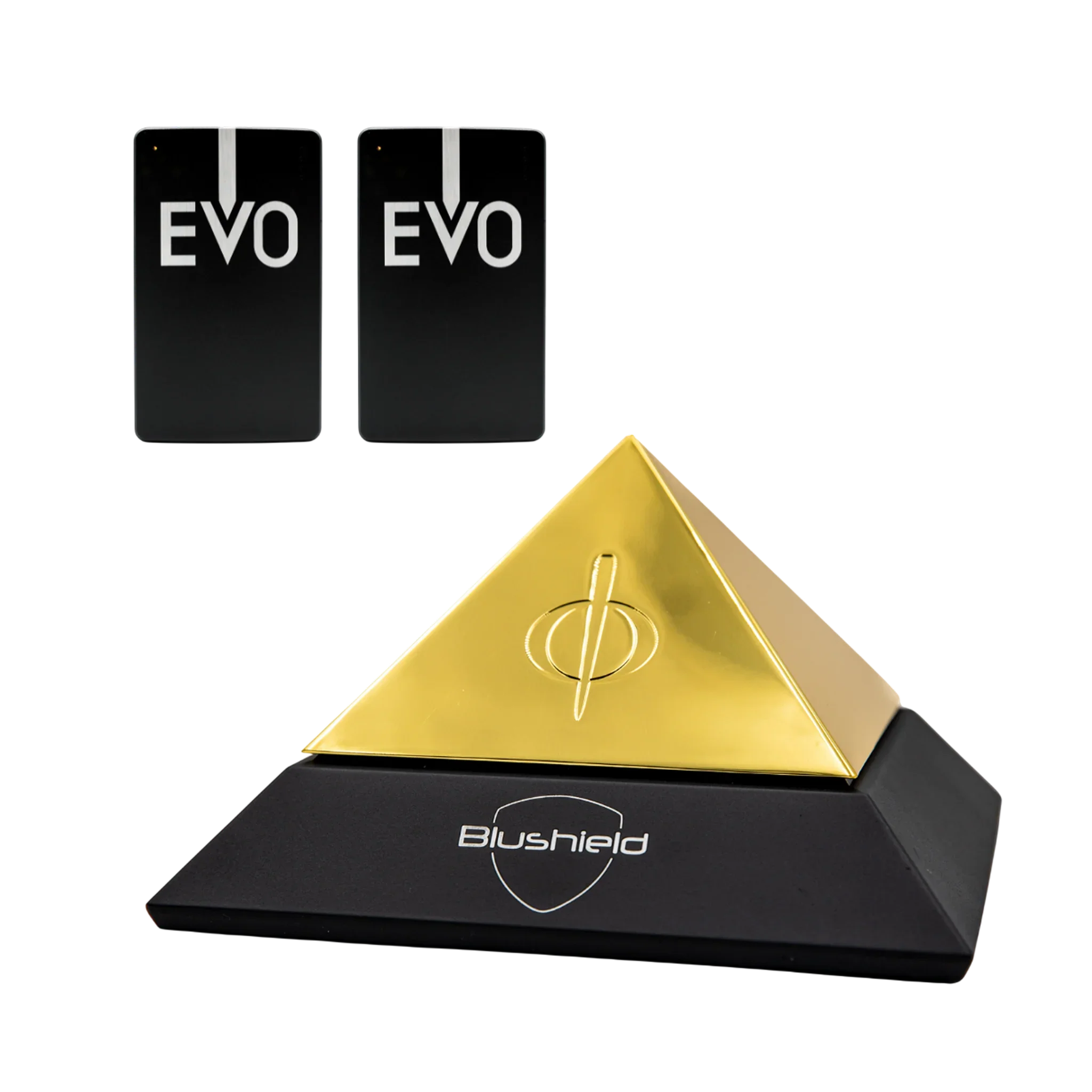
Jay: Interesting, okay. So you have multiple devices that you guys sell on your website. You made mention that the bread-and-butter of what you guys use, for the scalar technology, is the Cube, or the one for home. So why is that device the one that you think would be the go-to, and not just the portable one that we carry with us everywhere?
Brandon: That's an awesome question. We get that quite often, because a lot of people that are on a budget, they're like, can I just use this and not have to get a home unit? Yes and no. If that's your only option, it's better to have a little bit of protection than not. The lithium ion battery is just not strong enough to create the level of strength it takes to get entrainment. So they're designed essentially to be used in tandem. So your primary, if you had to buy one or the other, we always recommend going with the home unit. It's a lot stronger, it's using the 120 volts out of your wall socket, it's creating a much stronger signal, and that will lead to sympathetic resonance faster. Meaning, we want to get your body to seek out these signals in the environment, and ignore the chaotic EMF that's all around us from all our neighbors’ Wifi and everything that's going on in our environment.
That one gets you entrained, and then once you're outside your protected zone, and you're going to the store or running errands or doing your daily thing, going into a meeting, you take your Portable with you, and it's enough to be a reminder at the cell level to maintain that resonance. That's what we found in all our research, is the home units were kind of the original, and we wanted to make something that's totally portable, but with 5G coming out and just this insane amount of cell towers being posted up all the time, we realized that the strength needed to be there. Then the portables are kind of like for traveling on planes, and keeping your body entrained once your body is already acclimated.
Something else for people to know is it is possible, and about 60% of users -- I don't know if it will be so much the people listening that are really into taking care of their bodies, and health, unless they have something under the surface that's going on that they don't know about -- it's possible to get a detoxification reaction, because you can't really fake the biology. If the cellular coherence is going up, your zeta potential, oxygenation of the blood, all this stuff is happening at a higher rate than before, you're basically using something like Blushield to make your body stronger and more resilient, and if you've got stuff to clean in-house, the body's going to reallocate that immune power it's used to fighting EMF with, to cleaning the body, balancing, homeostasis, these kinds of things. So that's something to be aware of, as well.
Jay: Yeah, it's kind of like, in the field of psychophysiology, we have our sympathetic and parasympathetic state, and when we go into a state of override and sympathetic arousal, it can wreak havoc, we're in this chronic state. So we need to have this good balance between the sympathetic and parasympathetic sides, and I think this is the kind of device that allows that balance through your biology from an electromagnetic standpoint, which is a really cool thing, and kind of unheard of in much of health and wellness. So I think it's awesome that you guys are doing this.
I'm just wondering, let's say my body becomes entrained, and acclimated to my home device, and I've been carrying around my portable device everywhere, and then some days I just forget it, and I walk out without it. Is there going to be damage done? Is my body going to have to be retrained, or re-entrained, if you will? Or what goes on there?
Brandon: That's a really great question. What I've found, and what a lot of people who have been using it for multiple years now and give us feedback on, is you actually become stronger and more adaptive. It's not so much a dependency thing. When your physiology is strong for long periods of time, and you're able to navigate within the same crazy EMF pollution environment, your body actually becomes stronger. I've had instances where I would go to the store, totally forget it, and feel fine.
There's also interesting components, and I'll tell you a story. My wife, she is not the most energy sensitive person, as far as subtle energies go. She didn't really notice much when we put Blushield in our house. I noticed a lot of benefits, because my daughter was teething at the time, and we weren't sleeping well, getting kicked in the back, and having a rough go at night. What I found is I still wasn't getting great sleep, because I was being woken up at night, but had more energy and I was way more productive, and just felt more chill and calm during the day. I was like, wow, this is amazing!
My wife didn't notice a thing. But I noticed at that time, because she was working from her home office for a company at the time, everybody in the house was just more calm. That's the thing that people notice more about this technology, it has a peaceful, calm feeling in the house, but they might not really realize what's going on under the surface. So I'm saying this because, fast forward three years, she had an experience where she pulled up to Whole Foods, and she parked near this wall -- it was one of those concrete garage-style parking lots, and she just felt really weird all of the sudden. She's been to this store, I don't know how many times. She just felt weird that particular time, and then when she was walking in, she looked back and she noticed that she parked on the opposite side of a wall of a bank of smart meters.
So she actually became more sensitive over time to this kind of stuff, but not in a debilitating way, just more like canary in a coal mine. Like it's actually good to recognize and pay attention to this stuff, and be more energetically sensitive, but I think a lot of people associate that with becoming weak or compromised in some way. I've actually found the opposite to be true, that you're more resilient; of course I don't have any studies to back this up. This is just what I've heard from tons of users, and how I've felt about it. But yeah, you become more adaptive over time. I recommend you take it with you, especially if you're flying, and if you can remember it.
The inventor, Mark Langdon, he told me about this once and I thought it was pretty fascinating. He said that once the body is in sympathetic resonance with Blushield for long enough, that the body retains a 48-hour charge. So for 48 hours, your body is still feeling the effects of its last exposure, which I thought, man, pulsed magnetic fields don't even do that! I thought that was pretty interesting, and I think it's largely due to the fact that water absorbs scalar, and we're mostly water, so I think it stays in our bones and stays in the body a lot longer than just magnetic fields do.
Jay: Super interesting! Yeah, the body, and the mind, the brain, are so resilient, and so we don't want to discredit the body's ability to adapt to change. However, there are tipping points, I mean this is what illness is, this is when inflammation ends up taking over. We're all inflamed at some point in our body, and currently, everybody who's alive is inflamed in some way. This is a natural biological process that we need, or we do die. However, when it takes over our body, that's when we start to experience it, and we have to mitigate it.
I love the story you indicated there with your wife, because it doesn't go to say that she's become more sensitive to this, necessarily, but the body may just pick up on things, and it's kind of like, whoa! Back then I kind of adapted to it, even though it was wreaking havoc on my body, I adapted to it so I didn't notice it as much. But now that my body has truly found this healing source of energy to respond to, and not that one, then I'm able to kind of pick up on the subtleties and changes in my environment. That's what my guess is, is that's probably what was occurring. It doesn't indicate that she was more sensitive to these non-native EMFs, it's just that she was able to pick up on it more. So sensitive in the sense that she was more mindful of it.
Brandon: Right, and what's your new normal? There's homeostasis that you hit with everything, including Blushield, but that doesn't mean it's not working long term, because the way the algorithm's coded. That's the real distinction there, because anything you introduce into the environment is going to be warm and fuzzy at first, and you're going to feel like, ooh, this is new! Stimulus! But then most EMF products that I've ever found until Blushield, have this nice warm and fuzzy effect. Was it psychosomatic or not? I don't know, but it felt good, and then all of a sudden it didn't feel like it was doing anything for me.
Nowadays, it takes me like 3 or 4 days, if I forget to bring a Cube somewhere, like if I'm staying somewhere off-site from my house... I'll notice big time. The first couple days are fine, which correlates with what Mark is saying, but you definitely notice when you get out of it. It's no different than eating healthy, you know? You get on a good, clean diet, you're drinking structured water, you're doing everything right, you feel awesome at first. Then that awesome is your daily, if you do it long enough. But then you start getting back on junk food, you start becoming dehydrated, you're probably going to be good for a little bit of time, but eventually that's going to catch up with you, and you're going to have the same symptoms, the same effects that you had prior to starting the healthy lifestyle.
Jay: Absolutely. Great point, and well said. I wanted to share a little bit of my experience with the Blushield, just because it's been something I've been fascinated with. I've been using it for the past two months or so, and really, I try to never leave home without my Portable device. I feel like it gives me that bubble, like when I walk outside, I've got my protective little bubble around me, so when the EMF starts throwing spears at me, my scalar's just like, "Screw off, I've got you." I'm taking care of you.
One of the things that I will admittedly say is that like many other biohackers, I introduce a lot of new things for improving my overall health and wellness. I always say, from the get-go, please make sure you have the basics down before you're trying to invest in these things. When I say basics, I just mean having things like healthy levels of stress removed from your life, having things like exposure to sunlight, exposure to the elements, grounding, doing all the things that are basic, and then let's introduce some of these things in, too.
I find that a lot of people just try to play some patchwork or some band-aids on, almost like medications, when their lifestyle or behavioral changes haven't really been done, or moved anywhere. So do those things first, but then too, if you're looking for that extra biohacker's care, I think that this is a great option. I will also admittedly say that it's hard for me to pinpoint what is causing change, or tipping the needle in one direction, just because I do so much stuff. I integrate in different types of nutritional changes, supplements, other biohacks.
But I will say that when I introduced the Cube into my bedroom where my wife and I sleep, and it's actually right next door to my son's bedroom, as well, who is two -- and also, of course, I'm carrying the Portable unit around with me. It's interesting, Brandon, I would admit that I have felt that same thing that you were mentioning, that calmness. That feeling a little bit more at ease, and I noticed improvements in my sleep, as well. So I track my sleep via an Oura Ring that I wear every night. I've just noticed more sustained REM sleep, more sustained deep restorative sleep. I would like to attribute that to the Blushield, because I haven't really made many changes in my overall lifestyle, other than including this device into my atmosphere.
So I would like to say that a lot of these things are coming from Blushield. Again, I can't say that this is the absolute thing that's making it change, this is the cause for it, I can't say that it's not placebo, but what I can say is that for me it's been well worth having these devices on and carrying with me. I just wanted to mention my experience, just firsthand, because there's a lot of stuff that's sent my way, a lot of biohacking tools and companies that will approach me, and honestly, a lot of them I'm hearing the same old stuff. I really don't buy into it, or I use it and it hasn't had an effect on me. But the Blushield has been different, because I really enjoy and buy into this idea of scalar technology, I love the research that's on your website. I know we haven't gotten really into that. I love where this is going, and I think the more that we gain a better understanding of this, the more it's going to make sense as to what it's doing truly, inherently, in our biology, and for us from a psychological and spiritual standpoint, as well.
It's been really good. Have you heard about the whole sleep thing? Has that been an improvement you've heard from people, anecdotally?
Brandon: I've certainly heard about people getting better sleep. A friend of mine, Luke Storey, who is a brand ambassador, he had headaches and just felt a little off for the first week, but he started sleeping amazingly. Unbeknownst to him, he had a cell tower that was built into a building across the street from him. He didn't find that out until later. He talks about that a lot, I'm sure if you have listeners that listen to him. So I've heard about how it changes people's sleep patterns for the better, but I've never heard of anybody that's using an Oura Ring actually mapping it out. That's really cool.
Jay: Yeah, I'm a huge data nerd, so I'd love to actually quantify it and see if there has been a statistically significant change in the amount of deep sleep and REM sleep that I've gotten. Just kind of anecdotally, but also looking at objective data, I've just noticed that I've had longer bouts of REM sleep, I've had longer bouts of deep sleep. Again, whether that's attributed to Blushield I don't necessarily know, but the thing about it is I haven't made any other significant changes in my overall behaviors or lifestyle where I would say, you know what, it could be that as well. It's just a thing I've added in addition to those things and I've noticed these changes. It's pretty dang cool. I really like that this has been something that I can use and feel safe and confident in using it, like many other people. Like Luke, and others. It's good stuff.
Brandon: We're actually doing another round of animal studies, this time in the UK, for factory farms that are used for McDonald's, which is totally weird for me to say out loud, because I'm so into organic and local, as fresh food as possible. But it was an opportunity there, and they're documenting. Early on in 2000 we did the original poultry farm studies in Auckland, New Zealand, and just had phenomenal results. Chickens are interesting because they're very nervous animals, they're very loud animals, and you notice a lot of behavioral changes as far as how they become more harmonized just introducing Blushield into the environment. The fatalities went down; they get really anxious and nervous and they peck each other to death, so they lose an average of 60 to 100 chickens a month. That went down to zero within the first two weeks, then rose respectively 4 to 6.
This was a year-long study at that time. They did it for a year, just observed it, and the death rate never rose above 16-18 chickens a month, which is hardcore substantial when you think about how they were losing 60 minimum, to a hundred chickens every month. They had all that data. They had data on how many eggs they were laying, the density of the shells, they were measuring all of this stuff, and what they found is that it made them a lot more profitable because they were losing a lot less chickens, the egg quality is better, there's more of them.
Then McDonald's, we had a connection with these factory farms that produced for McDonald's in the UK, they're like, yeah we'd love to put these in if it's doing what you're saying it's doing. So we're putting that to the test right now, and working on more bloodwork. Because it is a subtle energy device and it's working at the subatomic structures between atoms, and there's very little known about consciousness and its superluminal effects. Consciousness is a phenomenon, it's in nature, it's in the universe, we just don't really know what it is.
We're trying to create that distinction with our technology, that this works whether you believe in it or not, whether you feel it or not. It's not psychosomatic, but we're still trying to figure out the mind connection with this technology, because a lot of people don't want to feel bad. Some people get detox reactions. It's funny, it tells me, you're telling me that it's working for you, but you just don't want to deal with the effects. A little advice for people that we've found actually works quite well, if you're experiencing any detox effects with these devices, one: power through it if you can. Stay hydrated, take systemic enzymes, adaptogens like schisandra. We offer a mineral product, Biocean minerals -- there's lots of companies that create these types of bio-resonant minerals from the ocean, and this is one of the cleanest sources we could find. But having those tools at your disposal will help mitigate that.
But if you can't power through it, if you have something chronic under the surface that we're not going to talk about, but you know what I'm talking about... the way to deal with the detox over a longer period, if it goes past that one to two weeks which is generally accepted, if people are going to have detox effects it's going to happen within the first 7-10 days. So if it goes beyond that and there's something deeper, where the body can't really handle the excess energy, or hold that excess energy... you can't distance yourself, because like I mentioned, it's the same power at 2 feet or 20 feet. You just unplug it. So it's like doing push-ups, right? You might be able to start with two push-ups. Do those two push-ups, and then the next day try three push-ups, and then try five, just incrementally increase your exposure until your body reaches that homeostasis over a long period of time.
Jay: Oh man, that's fascinating. One more study that I wanted to ask you about -- and that's really cool about being hooked up with McDonald's, there's a lot of room there, a goldmine for research -- but I know that you guys did some urine analysis on some human case studies. What did you find there? What were you guys looking for?
Brandon: So basically, the long and short of it is that when you're looking at urine analysis, you can find these free radical end products. We would just take the urine analysis of a diverse range of people. I think we did ten on that first study, and it was a 43-day period. What we found is the results of the test clearly show that the person had increased organ function and reduction of stress. So the stress markers, and then the free radical end products are what we were really testing, and those all went down, in every single case.
It was varied, depending on if the person was a smoker, a non-smoker, there's these percentages which you can read on the site, I don't recall them all right off the top of my head. Some of them had poor digestion, they were up late nights... so the healthier you are, the better it works for you. If you're still putting pollution in your body or you're just doing something you know you're not supposed to be doing, you're going to have a little bit less of an effect, just like with anything.
Jay: I think that makes total sense. It's like someone who's exercising a bunch, but they're still smoking, it's like, ehhh, I don't know if this is going to be nearly as effective as if you stop smoking, you change your diet, then you include exercise in. Then we're going to get a lot more positive effects from these other changes, be it small or large. So it makes total sense. It's really cool data that I'll link to in the show notes, that shows some of the urine analysis that was done for these ten case studies. I'm so excited for you to get some more research on this stuff so that we can see even more human trial.
Brandon: Yeah, and I called some of the same labs that the FDA study did, and they already dismantled everything they built, funny enough. You think you'd keep that for other research. But they were talking about the rebuild, and they quoted me a lot more than what the FDA actually ended up paying for that study. So it's one of those things, we're doing it at the scale we can, and what I'm going to do here locally, is I'm going to do some dark field microscopy. The way that light is refracted through that electron microscope, you can get a lot more detail, and you can really see the quality of the cell membrane. That's one thing you really can't fake with a blood test, because people debate, oh, if you just get hydrated or stand on a magnetic field, it'll affect the blood, which is all true.
But you can't fake the cell membrane, and the strength of the cell membrane, which Blushield clearly demonstrates in every single case. So I'm basically going to do some live video footage. I'm just going to make it more real for people, because no matter how much research you have, people always want more research... I'm more interested in diversifying the research. I want to look at effects on blood sugar, I want to look at heart rate variability, which some of the preliminary research that we did on that, is that apparently -- I didn't know this -- women and men’s heart rate variability is affected differently by scalar energy.
Jay: Wow, I would be so fascinated to see that, because that's one of my areas of study.
Brandon: Yeah, men tend to respond to the Blushield much faster in heart rate variability, than women do. So I want to look at all these things, because you know, EMF affects the calcium channels, it affects blood sugar and leptin response. There's a lot of components that could be looked at. But to do all those things individually, it's obviously reductionist scientific method, it takes time and energy to get everything together, but that's what we're really focused on.
For now, out of the sheer amount of Blushield we've sold in 12 countries, and having a less than 1% return rate, I think that speaks for itself, because a lot of people don't feel changes on the cellular level. I think it's just a healthy insurance to have, you're really investing in your health on all these other things, and I think certainly more valuable than getting that 2% edge with shining something on you or putting something up to your head, that 2% edge you can get. This is a very substantial level of pollution that's in the environment, and unless you're protected on the cellular level, I don't think, personally from what I've experienced and what I know to be true, is that you can't really block -- we're all on this planet together, you can't really block yourself from this stuff. Certainly not in the future when it becomes more, when these 5G satellites become activated in the upper atmosphere.
Jay: Exactly. Which is a scary thing to think about. I just wanted to point out one thing that you mentioned, because I think that it is absolutely incredible, and I remember hearing Luke Storey mention it, but I think it speaks volumes that your company has made all these sales internationally, and has a less than 1% return rate. That speaks enormous volumes, because I don't know any other companies that are receiving less than 1% in returns. So I have a lot of people who go on, and they look at the Blushield devices, and they think this sounds really cool but it tends to be a little bit pricier. I say that, yes, it might be, but again too, we have a company who, they're not getting people returning these things. People actually think that when they invest their money, they are actually getting a return on their investment. So I think that's incredible, man. You guys have done well.
Brandon: Yeah, it's shocking, because when I got involved and signed the NDA, and got to look more behind the scenes at the product, and had several video calls with Mark, who is the founder and co-inventor of the technology… when I really started to realize that it's legit and that almost nobody knew about this stuff over in the United States, I wanted to help spread the word. How many people are actually in their body, and feel what's going on, on a regular basis? Most people don't do that kind of training, sensitivity training. So I expected a certain percentage of people not to get it, not to feel it, but it's been shocking to me, to say the least.
Jay: Incredible. But yeah, again, I think it speaks volumes. So one of the things, before we wrap everything up today, a question that I had for you. I know we didn't get too deep into this topic, and we might have to save it for another time because we could probably spend many many hours on this one. But my question is, we are about to take a shift that, in my opinion and in many opinions, especially in the biohacking community, are very nervous about. It's this whole 5G switch.
So my question to you is, is Blushield going to be enough for this? Are we going to be able to utilize Blushield and scalar technology as a primary defense, or is something going to have to be done differently here for this whole change in 5G?
Brandon: It's already 5G-ready, based on the principle of how it's working. So, short of ionizing radiation, it doesn't matter what frequency bandwidth -- the signal is going to compete, your body will always move towards what's beneficial and away from what's not. Bruce Lipton, in his book Biology of Belief, he referenced some of that research, the petri dish research where they had the influence of scientists, because human cells are resonant with humans, so thought can affect things. So they took all the scientists out of the room, they video taped it, and they put things that are beneficial and things that are detrimental to the cells. In every single case, the cells would migrate to the site of the petri dish which was closer to what was beneficial... essentially proving that there's an innate intelligence at the cell level.
So the way we amplify the signal, the way we transmit the signal, and because scalar is 5-6 times more influential than Hertzian waveforms, it's already 5G-ready. We do have a Premium Series Ultra, which is really an amazing system. It's got a little bit more, it's got another microchip, essentially, and it's running more like Fibonacci sequence frequencies that will help with cell repair. But that's only really for people who are like, line of sight of a cell phone tower -- like if you have a 5G repeater right outside your house, or you're in direct line of sight of it. That's the most dangerous place to be. So if you're getting that mild radiation all the time, depending on what amplitude it's set at, the Premium Ultra is pretty much what you want if you're in the inner city.
Unfortunately, the infrastructure has to be so vast to get 5G working. You'll see on a lot of carriers, I don't know if it's AT&T or different carriers, you'll see like 5GE, or 5G-something. It's not true 5G. They don't have the real infrastructure. The rumor is that T-Mobile is going to beat everybody there, because they're putting more money into it, but nobody's really stopped to think, is this a good idea? What's going to happen to the wildlife, especially with the satellites. That's just crazy! They're wanting to connect the whole planet, but that's going to irradiate a whole vast amount of the planet that's never seen this type of radiation.
Jay: Yeah, and they're just going to throw a bunch at it at once! The ramifications of that, I guess unfortunately we're just going to have to wait and see.
Brandon: Fortunately, the body is adaptive, fortunately we have Blushield technology. I think the more conversations we have around it, the less it will be a weird conspiracy theory, because that's really where it is now. But it's plain as day, you can see the military patents on 5G. In fact, it's not that far out, if you think about where microwave ovens come from. Back when Navy men were on ships, they would get cold, and they found when they stood close to the radar, they would warm up. So that technology kind of came from figuring out, oh, this can heat things. So let's apply it to cooking food.
Jay: Well, in the end it's good to know that if anybody out there does go about and pick up some Blushield devices, that these are 5G-ready. So that's really good. The Bruce Lipton analogy is really important, because I think it really holds true for this. I know people like Jack Kruse talk about 5G and how damaging this could be, but when you ask him about it, he doesn't say he's nervous about it, because I think we understand that there's something that we can do. We're not just helpless in this situation.
Brandon: Is he the chicken wire guy, who says you can just wrap yourself in chicken wire and block EMF?
Jay: No no no, at least I don't think so. I mean, that sounds like something he could say, but no, that's not him. *laughs* I wanted to point out one more thing before we wrap up. I know you have this chart on your website that shows a lot of different things about the devices, both the portable and stationary protection, the ones that are grid-powered and the ones that are rechargeable. What I like about it is it shows the strength and the magnitude of strength, and it also shows the distance it covers. So for instance, if you've got a portable device on you, it covers like a 3 meter radius. Then the Cube covers a 90 meter radius. So I think that's a really useful chart. Is everything up there still up-to-date as far as the radius it covers?
Brandon: Yes, that's correct. We're coming out with some new products. One of the ones that went away was called the Disc, where you could wear it as a pendant or wear it as a watch. My opinion, it had some design flaws, so we're looking at making that more of a functional thing that you can wear, like a watch or something. So we're working on that now. Some of the visuals might be a little bit outdated, but the numbers and the math are current.
Jay: Gotcha. So again, just to wrap us up, if you are interested in the Blushield technology and want to read more about it, I'm going to link to that in the show notes at DrJayWiles.com/EMF. You can head on over to Blushield's website, that's blushield.com, where you can find all the devices, and Blushield has been so awesome to give my listeners a discount code. So if you use code DocWiles, you will get you a nice little discount, I believe it's 10% off. Every little bit helps, right?
So head on over, pick up some of the devices. Again, I have the Cube, which is the home device, as well as the Portable device, and it's just something I carry on me all the time. Even though I'm inside right now for the podcast, I wanted to have the Portable one next to me. So I've got that one sitting in front of me now. But as I run out here in a few minutes to head out to a lunch meeting, I'm going to carry that one with me so I'll be nice and protected.
So Brandon, I can't thank you enough for being on here. Thank you for coming on and sharing all your wisdom, and for getting us nice and deep into some scalar technology.
Brandon: Yeah, thanks for inviting me, Jay, I appreciate it. I appreciate what you're doing to help people be healthier and more conscious.
Jay: Absolutely, man! Well, that's going to wrap us up today for this episode of Mindhacker's Radio. Make sure you head over to the website, DrJayWiles.com/EMF for all today's show notes. It's a lot of work to update those and get you guys all the information.
You all take care, happy new year again, welcome to a new decade, and have a great week.
This post copyright ©2020–2026 Blushield USA. All rights reserved.
Unauthorized use and/or duplication of this material without express and written permission is strictly prohibited.
Explore more Articles
The Science of Stability: Why Powered EMF Protection Outperforms Passive Devices
In our increasingly hyper-connected world, the conversation around Electromagnetic Fields (EMF) has shifted from "if" we should protect ourselves to "how" we should do it. As we surround ourselves with 5G towers, Wi-Fi routers, and smart appliances, the market has been flooded with solutions ranging from stickers and crystals to sophisticated electronic resonators.
However, not all protection is created equal. To understand why some methods fail where others succeed, we have to look at the physics of signal dominance and the biological need for a coherent reference.
The Passive Problem: The Limitation of "No Power"
Passive EMF protection products such as shungite, specialized stickers, or unpowered pendants operate on the principle of attenuation or local field alteration. While these materials may have unique molecular structures that interact with frequencies, they face a fundamental "physics wall": they lack an internal energy source.
Without power, a device is purely reactive. It cannot create a signal; it can only respond to the signals already present in the room. This leads to three critical failures in a modern environment:
01. Lack of Signal Dominance
For the body to prioritize a "healing" or "balancing" frequency over the chaotic noise of a Wi-Fi router, that frequency must be dominant. Passive devices are essentially "whispering" in a room where the EMF environment is "shouting." Because they cannot project a field, their influence is limited to the near field usually just a few millimeters or inches from the object.
02. The Trap of Ambient Fluctuations
Passive devices are at the mercy of their environment. If the ambient EMF levels spike (like when you take a call or download a large file), the passive device has no way to scale its interaction. It cannot maintain a structured reference signal because it is constantly being "pushed around" by the very frequencies it is meant to harmonize.
03. No Timing or Pulse Control
Biological systems are highly sensitive to rhythm and timing. Active EMF protection often uses specific pulse-width modulation to mimic natural Earth frequencies (like the Schumann Resonance). Passive devices have no "heartbeat"; they lack the circuitry required for timing control, meaning they cannot provide the rhythmic consistency the body needs to stay grounded.
The Active Advantage: Establishing a Coherent Reference
Powered, dynamic signaling systems represent a different paradigm of protection. Instead of trying to block or absorb radiation which is nearly impossible in a modern home these devices focus on Active Resonance.
Building a "Safety Bubble"
A powered device uses a dedicated power source to emit a consistent, coherent, and structured electromagnetic field. Because this signal is generated internally, it is not dependent on the noise of the room. It creates a stable "reference point" that remains constant regardless of how many devices are active in the house.
Conclusion: Why Power Matters
In the quest for wellness in a high-tech world, we must choose tools that match the scale of the challenge. Passive materials certainly have their place in history and personal practice, but they lack the "active voice" required to compete with the high-output infrastructure of modern telecommunications.
If the goal is to create a true sanctuary a space where biology can rest independent of the changing electromagnetic tide a powered, dynamic system is not just an upgrade; it is a necessity. By establishing a dominant, coherent reference signal, we provide our bodies with the stability they need to thrive in the digital noise.
Did you know that your smart phone settings include a section that advises usage habits to reduce RF (radiofrequency) exposure?
This advice is included even though all smart phones proclaim that they are in compliance with the government’s SAR (Specific Absorption Rate) safety limits.
If the radiation emitted by cell phones was truly safe, why would they bother to tell you ways to reduce radiation exposure? Could it be because the SAR limits are outdated, and only address thermal (heating) effects of non-ionizing radiation exposure, and ignore the mounting evidence of harm from non-thermal mechanisms?
Let’s dive into this revealing topic that most people are unaware of, even though the majority of us are smart phone users.
You can check your own smart phone now. If you have an iPhone, just go into the Settings, then click General, and there should be a section called Legal and Regulatory. If you click that, and scroll all the way down, there should be a section titled RF Exposure. This may look slightly different on Android phones (like Samsung and Google Pixel), but you will find something similar if you investigate.
This section should display the results of the SAR test for your phone model, which of course will be within the “safe limits” for radiofrequency radiation exposure. If you have an iPhone, you may see something like this:
"To reduce exposure to RF energy, use a hands-free option, such as the built-in speakerphone, headphones or other similar accessories. Cases with metal parts may change the RF performance of the device, including its compliance with RF exposure guidelines, in a manner that has not been tested or certified."
Why advise reducing exposure, if the exposure level is already safe?
A Google Pixel phone we looked at, which tested at well within the SAR safety limits, even included this statement: “Keep the device away from your body to meet the distance requirement.”
What distance requirement? The SAR tests state that when the phone is placed directly against the head, or within 5mm of the torso of the body (to simulate the phone being in a pocket with a thin layer of clothing in between the phone and your skin), that you are “safe”, according to standard tests.
The Samsung S21 smart phone fine print informs that their SAR distance for safety is 15 millimeters, which is equivalent to more than half an inch. Most people place their cell phones directly against their head when making calls, as they have never been informed to do otherwise. If a Samsung S21 phone user is making calls in this way habitually, the company’s own recommendation implies that the user may be exposed to unsafe levels of RF radiation on a regular basis. Yet, this is not widespread knowledge, and is only in the fine print that most people don’t know exists!
Samsung also states, “Specific Absorption Rate (SAR) certification establishes a minimum recommended distance from a person’s body for safe operation of RF-emitting devices. Body-worn operations are restricted to belt-clips, holsters or similar accessories that have no metallic component in the assembly and must provide at least 1.5 cm (3/4 in.) separation between the device and the user's body.”
Did you ever hear any of this from a cell phone TV commercial or online advertisement? We certainly haven’t.
Pharmaceutical drugs are legally required to list their “fine print” of potential side effects, even on TV commercials. Why aren’t cell phone companies required to at least give you a brief warning about RF radiation exposure before you purchase their products, and suggest ways to reduce exposure?
It’s also important to note that having Wifi and Bluetooth enabled on your smart phone will significantly increase the RF radiation output of the device. Many people keep both of these turned on continuously or at least periodically, and do not consider the additional radiation exposure they may be getting, which may often be higher than the SAR safety limits.
The Specific Absorption Rate (SAR) limits are too high, and not healthy
Cell phone companies and the FCC seem to enjoy splitting hairs about the details of the SAR limits, and are quick to point out that the SAR test scores that phones list are at their maximum radiation output, implying that most usage is going to fall at far lower levels than the output listed on the test results.
If we’re going to argue at this level, it’s good to know that many phones may not actually be compliant at all, according to independent tests performed in 2019. If the cell phone company itself performs the tests, and the results can’t be replicated independently, then can we trust them in the first place?
However, let’s move past this type of nitpicking for now, and talk about why the SAR limits are inherently flawed and dangerous in the first place.
As stated earlier, the Specific Absorption Rate is only testing the thermal effects of cell phone radiation, meaning how much it heats localized tissue. That is the only mechanism of harm that the telecoms and FCC are willing to admit to. For a minute, let’s pretend that this is the only mechanism of harm. Even if that were true, there are significant flaws with the SAR safety limits.
The SAR safety limit was originally set in 1996 – 30 years ago. They modeled the body proportions of Army personnel, who are generally large, fully grown men, often around 6 feet tall and 200 pounds. This model does not come close to representing smaller and more developmentally vulnerable populations like children, teenagers and pregnant women. Grown men are generally the most resilient category of humans to toxic exposures of all types, whereas babies, children and developing embryos and fetuses are the most fragile. Babies and children have smaller heads, thinner skulls and rapidly developing brains that are highly vulnerable to harmful environmental influences, including wireless radiation.
The SAR rate that was set in 1996 has not been updated at all over the past 30 years, even as new cell phone technology and usage habits have evolved seemingly at light speed. The maximum distance that a phone could be tested at to achieve compliance was up to 25 millimeters, which is much further from the body than where today’s phone users keep their phones. The 25mm distance was set because in the ‘90s, people often carried their flip phones on belt clips, which were about an inch away from their body. Almost no one uses belt clips anymore, and most often, the phone is carried in a regular pocket, which is generally only 2mm away from body tissue, especially vulnerable reproductive organs like the ovaries and prostate. Guidelines have not been updated to reflect changing habits of users, nor have users been adequately warned of the potential harm of keeping their phone that close to the body.
There is also no consideration for long term exposure. Regulations are set based on immediate effects, with no thought for the many decades of consistent cell phone and other wireless radiation exposure that most modern people, especially young people, will experience in their lifetimes.
Regulations also do not acknowledge the fact that people generally no longer carry just one wireless device with them, but use multiple RF emitting devices regularly: cell phones, tablets, Bluetooth speakers and headphones, vehicle GPS devices that connect to Bluetooth, smart devices that connect to your smart phone, and much more. All of these sources multiply our RF exposure to levels that are currently unknown, and unacknowledged by official government and telecom industry sources.
We are stuck with the ancient 1996 SAR guidelines, which were created in a vastly different technological world than the one we live in today.
Thermal effects are not the only concern with wireless radiation
Lastly and most importantly, the SAR safety standards are based on the (proven erroneous) assumption that the thermal effect is the only way that cell phones can cause harm.
In the early 2000s, the National Toxicology Program, an arm of the U.S. Government’s National Institutes of Health, performed the largest, longest study on the health effects of cell phone radiation that had ever been done up to that point. Their stated intention for the study was to find out whether there were non-thermal health risks to cell phone use, since the only safety guidelines that existed at that point were the SAR safety limits, which were only based on thermal exposure risks.
This is an entire story in itself, but suffice to say that considerable harm related to cancer and DNA damage were found – results that were surprising to everyone involved in the study. After a brief period where a peer review panel of experts declared that the study was well performed and showed clear evidence of cancer and DNA damage, the government agencies involved subsequently pivoted in their opinion and decided that the study was NOT relevant to human exposure. If you haven’t yet read this whole story, you will want to, as it shows beyond any doubt how egregiously biased the United States government is towards siding with the telecom industry.
$30M National Toxicology Program Study Shows Cell Phone Radiation is Carcinogenic (full story)
The most important thing to realize is that science shows that non-ionizing radiofrequency radiation, at below-thermal levels, can be harmful to health. Whether or not a mechanism has been definitively recognized that accounts for this non-thermal harm, the harm itself has been documented in hundreds to thousands of studies, many of which you can read about here.
If you’re interested in purported mechanisms of non-thermal harm, the most probable theory at this time involves the voltage-gated ion channels of the body, and how external electrical signals trigger these highly sensitive voltage-mediated channels to flood various minerals (especially calcium) into the cells, triggering a cascade of unintended and unwanted effects. This mechanism has been extensively studied by Dr. Martin Pall, and has been discussed in at least a dozen of our other articles.
Don’t fall into the trap of blind trust – protect yourself
Ignorance of the truth won’t protect you. It is the fault of the government and telecom companies that it isn’t common knowledge that your daily wireless device usage may cause health issues over time. However, it is your responsibility to educate yourself, and to protect yourself as well as you can. Most people are not going to give up their cell phones entirely, but there are things you can do to significantly reduce your exposure:
- Never carry your cell phone in your pocket, or anywhere against your body, unless it’s turned off, or set to airplane mode.
- Never sleep with your cell phone near you, unless on airplane mode with Bluetooth and Wifi disabled, and even then be sure it’s at least a few feet away – definitely not under your pillow or near your head.
- Never hold your phone up to your head when you talk. Instead, use speaker phone or an AirTube headset (which has a tube of air instead of wires all the way to your ears) to make calls.
- Limit your children’s cell phone and tablet exposure, and be cautious during pregnancy and around babies.
To protect your body from any remaining radiation exposure, since you can’t control a lot of the RF exposure sources around you, be sure to protect your home with a stationary Blushield device of the appropriate strength for your overall EMF exposure levels, and carry a Blushield portable device with you anytime you’re on the go.
Blushield devices were demonstrated in a 2023 clinical study to calm overactivation of the voltage-gated calcium channels back to normal levels – VGCC overactivation is widely thought to be the primary mechanism of harm from EMFs, as we touched on earlier. A variety of other statistically significant health improvements were recorded, as well, showing that even if the mechanism of harm from non-thermal EMFs is more complex and nuanced than we currently know, that our EMF protection technology is broadly beneficial in regulating physiology back to a healthier state.
References:
- Apple iPhone RF Exposure Information – https://regulatoryinfo.apple.com/rfexposure/iphone18,1/en
- Samsung Galaxy S21 Radiation Levels – https://www.rfsafe.com/phone/samsung-galaxy-s21/
- Blushield: “New Proof that Cell Phones Are Not Safe” – /blogs/new-proof-that-cell-phones-are-not-safe
- Blushield: “$30M National Toxicology Program Study Shows Cell Phone Radiation is Carcinogenic” – /blogs/30m-national-toxicology-program-study-shows-cell-phone-radiation-is-carcinogenic
- Bioinitiative Report (updated in 2022) – https://bioinitiative.org/table-of-contents/
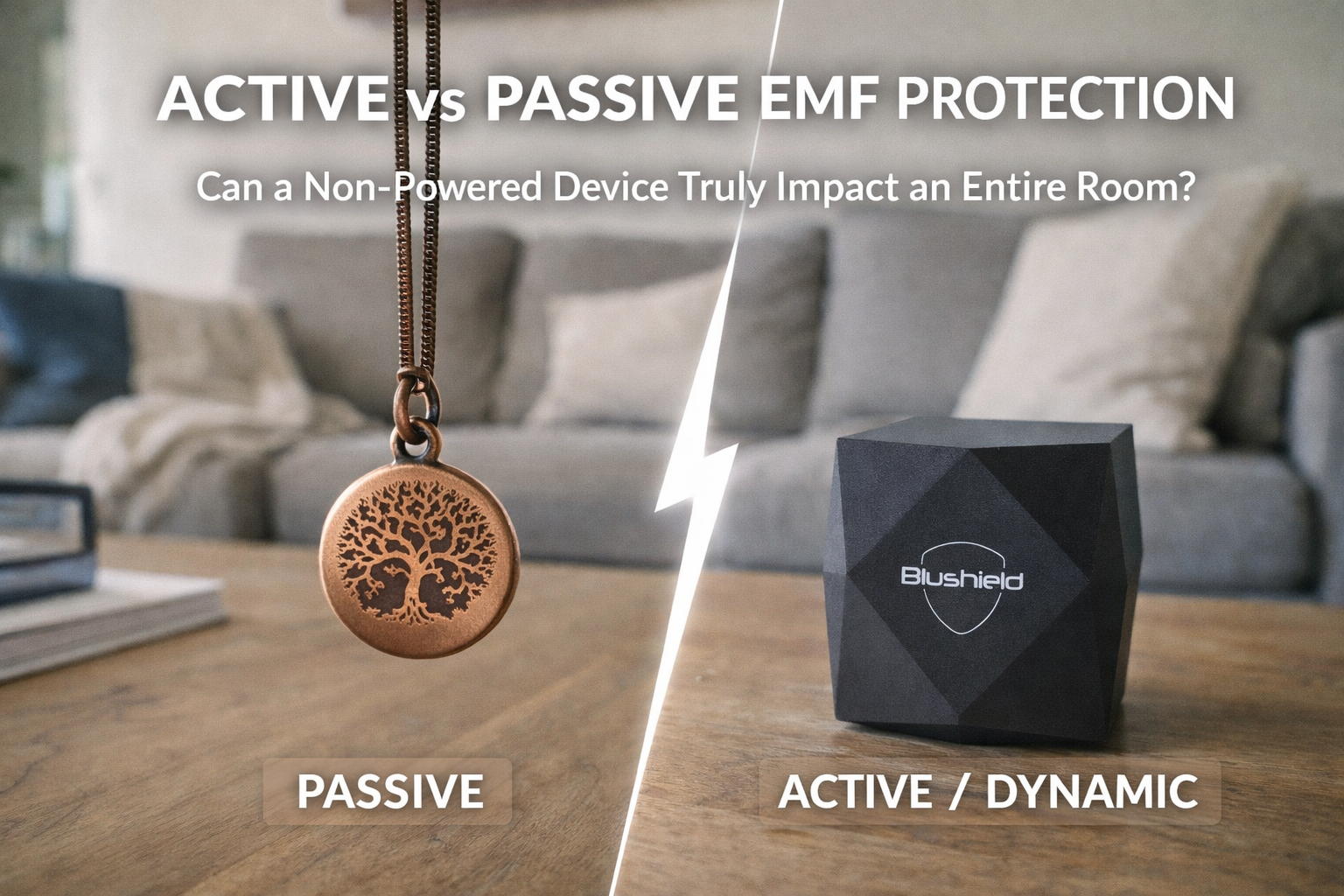
Why I ultimately chose active and dynamic field signalingMy name is Brandon Amalani and I have been running Blushield.com for nearly ten years.People regularly ask me about passive EMF protection devices and whether they are reliable or effective at protecting biology from man made electromagnetic exposure. That question comes up more now than ever, especially as passive devices have become extremely popular in recent years. I want to be very clear from the beginning that this article is not an attack on anyone or any company. It is an honest attempt to explain what I have learned about physics, biology, and signal behavior after a decade of working directly in this space.I originally got involved with Blushield after personally exploring many of the options available at the time. Most of what existed were passive EMF devices such as stickers, pendants, resonator chips, cards, and other non powered products. There were also shielding materials, grounding strategies, and constant single frequency generators. I tested all of these myself and spent a lot of time learning where each approach worked and where it clearly did not.That was about ten years ago. Since then I have worked closely with inventors and researchers in the electro therapy space and continued my education across multiple disciplines including cold plasma technology, photobiomodulation, PEMF system design, cellular biology, nutrition, and herbalism. Having this cross-disciplinary perspective has been critical in helping me understand how the human body functions as an electromagnetic system and how it interfaces with both natural and man made fields.Over the years I have noticed a shift in how passive EMF devices are discussed and marketed. Many educators and companies have moved away from older language like depolarizing EMF or harmonizing waves, and are beginning to use more nuanced terminology around coherence and biological signaling. That shift is a step in the right direction. However, based on what people share with me and what I continue to observe, there is still a great deal of confusion around the actual physics and biology involved.There are really three categories worth discussing. The first category is passive EMF devices. These devices have no power source. They claim to harvest ambient electromagnetic radiation and reorganize or modify those fields in a way that reduces biological stress. They often rely on geometry, fractal patterns, holograms, microchips embedded in pendants, or specific material combinations. The second category is active EMF signaling devices. These devices are powered systems that intentionally emit weak structured signals. They do not claim to overpower ambient EMF. Instead they claim to bias biological systems toward more coherent endogenous signaling and improved physiological resilience. The third category is what I would call active and dynamic signaling systems. Blushield falls into this category. It is active because it generates a field using an internal power source. It is dynamic because the signaling changes over time in a coherent way, more closely resembling the constantly shifting electromagnetic environment found in nature.To be clear, many of the concepts used to justify passive devices are not crazy or unscientific. Electromagnetic fields do have polarization. Geometry can influence how fields interact with materials. Fractal antennas exist in real engineering applications. Metals can couple to radiofrequency energy and act as grounds. Passive objects can scatter or redirect fields locally in the near field. All of that is true. This is why claims like an intentionally designed resonator can reorganize harmful EMFs and make them less biologically stressful sound persuasive on the surface.The issue is not the concepts themselves. The issue is scale, control, and guarantees.A passive resonator may produce higher local field intensity at specific frequencies by storing energy temporarily, much like a tuned antenna. However, this is concentration, not amplification in the engineering sense. Without an internal power source and maintained oscillation, a passive device cannot generate a dominant reference signal or enforce coherent structure across a room-scale environment.Without power, a device cannot control timing, phase, modulation, or coherence. It is entirely dependent on whatever ambient electromagnetic environment happens to be present at that moment, which is constantly changing. Geometry without power has no authority over signal behavior. Passive devices can respond to fields, but they cannot impose order on them.Over the years I have had many conversations with inventors working in active electromagnetic systems, including plasma based technologies. One important distinction that comes up repeatedly is that plasma can behave like a fractal antenna because it is an active medium with mobile charge carriers and energy input. That is fundamentally different from static geometry, etched holograms, or water/copper coil circuits which do not maintain oscillation, timing, or coherence on their own.Fractal antennas are real in engineering. However, they require specific parameters such as tuning to defined frequency ranges, feed points, impedance control, and known boundary conditions. A static hologram etched onto a pendant or card does not dynamically store electromagnetic information, adapt to changing environments, or enforce coherent signaling. It is a constraint, not a reference. Plasma systems can act like fractal antennas because they are active. They contain mobile charge carriers, dynamic oscillation, and energy input. That is a fundamentally different physical system than a static etched interference pattern. Calling both of these fractal antennas is a category error.One question that always stood out to me was how passive devices claim to cover large areas with no internal power source. Passive devices may slightly alter local coupling when worn on the body. That is plausible. What is not clear is how they could control room-scale fields or guarantee uniform effects across space. If a device truly created a dominant room-scale field, orientation, placement, and surrounding electromagnetic conditions would not matter. In reality, indoor EMF environments are dominated by near field sources such as laptops, phones, routers, and wiring. These signals reflect off walls and floors, creating standing waves and nulls. The result is a highly patchy and inconsistent field landscape. A small passive device only interacts with the local field where it is placed. It cannot average or reorganize an entire room. Its behavior will change depending on proximity to sources, wiring, and the body itself. That tells us the environment is in control, not the device.Passive devices have no internal timing reference, no phase authority, and no feedback mechanism. A passive microchip or circuit does not qualify as an internal reference because it does not actively maintain timing, state, or phase. Geometry and materials can constrain how a device responds to incoming signals, but they cannot enforce or stabilize a desired signal state. A reference requires actively maintained timing or coherence. Passive systems do not have that capability.Depolarization is another concept that has been widely misunderstood. Polarization refers to the orientation of the electric field. Coherence refers to phase stability and predictability over time. These are not the same thing. Modern radiofrequency environments are already spectrally complex, weakly polarized, and highly incoherent. Further depolarizing these fields simply adds randomness. It does not restore order. You cannot fix incoherence by adding more noise.In recent years many companies have used portable EEG devices to demonstrate before and after changes in brain activity. EEG can certainly reflect changes in mental state such as relaxation, attention, novelty, or expectation. It is extremely sensitive to posture, breathing, emotional framing, and context. What EEG cannot demonstrate is environmental EMF control, room-scale field effects, or mechanism of action. EEG does not measure cellular health, gene expression, calcium channel behavior, oxidative stress, or electromagnetic exposure levels. It tells you that a brain state changed, not why it changed. A device worn on the body could plausibly induce a local coupling effect. That does not mean the surrounding environment was altered. Small numerical changes can also appear dramatic depending on visualization choices and color scaling when creating before and after images.After evaluating many testing approaches, we chose to pursue the most rigorous path available to us. Rather than relying on internal or externally sourced white papers or theoretical models, we conducted an independent review board certified clinical trial in the United States. The results were published in a peer reviewed medical journal. We demonstrated significant changes in VGCC gene expression along with other physiological markers. This type of research is expensive and time consuming, but it aligns with the actual biological mechanisms being discussed.Biological systems are oscillatory, nonlinear, phase sensitive, timing dependent, and reference driven. This is why natural light cycles, geomagnetic fields, and environmental rhythms are so important to health. Biology does not simply respond to less stimulation. It responds to better organized information. The real question is not whether we can remove all EMF. It is whether we can provide a stable coherent reference that biology can lock onto.Active and dynamic signaling systems can do this. Passive systems cannot. Powered systems introduce a reference signal with internal timing and structure. That signal behaves consistently across environments. It improves signal to noise at the organism level. Passive systems have no phase authority, no internal timing, and no ability to resist environmental variability. They react to chaos, scatter chaos, and depend on chaos for their function. That is the opposite of what biology needs.Even mainstream EMF literature points to mechanisms such as VGCC activation, calcium influx, oxidative stress, and redox imbalance. An active coherent field can plausibly bias ion channel behavior, reduce stochastic noise, and support mitochondrial coupling. A passive scatterer cannot target these mechanisms or maintain biological reference states. Passive devices attempt to reorganize biology by harvesting incoherent ambient radiation. Active devices introduce order.We have been recommending Blushield for years as ones primary source of protection. Recently we introduced another technology that we found to pair perfectly with Blushield as the ultimate EMF protection stack.First, let’s look at the environment a bit closer.Modern EMF exposure isn’t just coming from wireless signals in the air. It also comes from the wiring inside our walls. Digital devices, switching power supplies, and LED drivers inject high-frequency transients and sharp voltage edges onto the 50/60 Hz electrical sine wave. That noise doesn’t just stay in the wires, it turns the wiring itself into a secondary source of electromagnetic variability.Blushield operates in the radiated domain by introducing a low-power, internally timed reference signal that remains stable even as the surrounding RF environment changes. It does not attempt to overpower external sources. Instead, it provides a consistent signal structure that biology can bias toward.SineTamer works at the electrical layer by reducing high-frequency transients and rapid voltage fluctuations on the building’s wiring. By lowering broadband electrical noise, it reduces the background variability that wiring can radiate into living spaces.Together, these two approaches address different layers of the same problem: one introduces structured reference signaling, the other reduces injected electrical noise. The result is not “shielding,” but a shift in signal organization and environmental stability.I genuinely want passive devices to be highly effective. I also want Nikola Tesla’s dream of a small portable device that produces clean energy from ambient energy to be real. But wanting something to be true does not make it physically possible yet. After ten years of experimentation, education, and direct testing, active and dynamic field signaling remains the most plausible approach I have seen for supporting biological resilience in modern electromagnetic environments.

Product updates
Practical tips for low-EMF living
New releases
Exclusive promotions
Frequently asked questions
Invisible forces are part of modern life, but their impact doesn’t have to define you. Blushield works quietly in the background, supporting a more stable, balanced internal state so you can focus, rest, and perform at your best.
It doesn't block or shield EMF. Instead, Blushield is designed to support the body's natural response to everyday electromagnetic exposure. By focusing on biological support rather than altering environmental signals, it takes a different approach to EMF protection.
Plug-in units (Premium, Ultimate, Phi) cover your home. Portables cover you when you leave it. Most people start with one of each: a plug-in for the house and a portable for travel, work, and the car. If you're not sure, use our Find Your Device tool or message us.
30-day limited money-back guarantee on every device (restocking fee applies - see our full return policy). Stationary and portable units carry a 1-year warranty. If anything extends past that, contact us.
Yes. EMF meters measure intensity, not biological impact. Even low-level exposure from Wi-Fi, Bluetooth, smart meters, cell towers, and nearby homes accumulates 24/7. Blushield works on the body's response, so it helps regardless of what a meter reads.
Some people feel calmer or sleep better within the first night. For others it's a few weeks of gradual change - better focus, deeper sleep, and less fatigue. A small number notice a short adjustment period as the body recalibrates. Everyone responds differently, so give it time to become part of your daily environment and let the benefits build naturally.
Yes. Blushield is built on decades of research into how the body responds to coherent vs. incoherent electromagnetic signals. We have independent studies, HRV data, and live-blood analyses on our Science page. We don't make medical claims. We point you to the data and let you decide.